
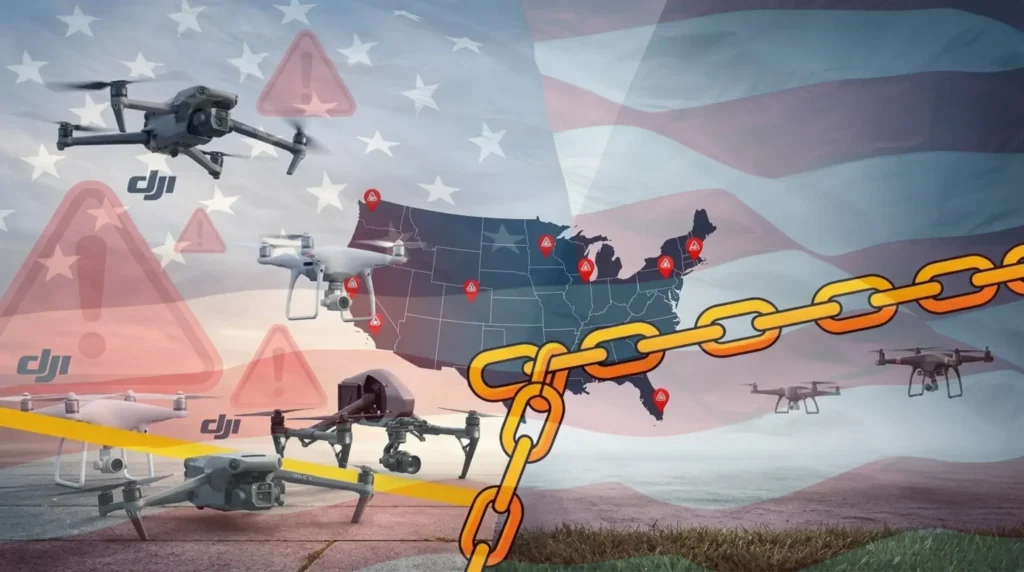
A mix of regulatory decisions, trade restrictions, and unfinished rulemaking has created significant challenges for the United States commercial and public drone sector. Industry leaders warn that the combined impact of these measures could hurt operators, businesses, and the public safety agencies that rely on unmanned aerial vehicles (UAVs) for essential operations.
DJI Restrictions: A Multi-Front Pressure
At the center of the industry’s concerns is Chinese drone maker Da-Jiang Innovations (DJI), which dominates the U.S. market. A Pilot Institute survey of more than 8,000 drone operators found that 70 percent operate fleets made up entirely of DJI UAVs.
Additionally, 85 percent have fleets where DJI drones make up at least three-quarters of their total inventory. DJI drones are nearly universal among public safety agencies, with only three percent reporting that they do not use any DJI equipment.
The Federal Communications Commission (FCC) added DJI to its Covered List in late 2025. This move effectively banned the use of future DJI models and their support equipment. Soon after, the 2023 American Security Drone Act took effect.
This law prohibits the use of federal funds to buy or operate DJI drones. It has significantly affected state and local agencies, as they rely on UAV programs that receive partial funding from the federal government.
While current and approved DJI models can still be used, access to these devices has become very limited. Under the Uyghur Forced Labor Prevention Act (UFLPA), U.S. Customs and Border Protection halted most DJI equipment shipments in 2025.
According to a survey by the Pilot Institute, 41.8 percent of respondents could not purchase a specific DJI model they wanted. Meanwhile, 33.3 percent could not get necessary parts or accessories, and 21.6 percent experienced significant order delays.
Vic Moss, CEO of the Drone Service Providers Alliance (DSPA), described the situation as “a multi-front attack” on the potential of the U.S. drone industry. DJI has disputed allegations related to the UFLPA, saying its manufacturing happens entirely in Shenzhen and Malaysia, and that the company is not on the UFLPA list.
DJI has also filed a federal lawsuit to challenge its inclusion on the FCC Covered List. Adam Welsh, DJI’s Head of Global Policy, said the restrictions will greatly harm the life-saving efforts of American public safety agencies and the livelihoods of many small business owners.
The Case for U.S. Drone Manufacturing
Proponents of domestic drone manufacturing argue that restricting DJI’s access to the U.S. market allows American companies to expand. Michael Robbins, president and CEO of the Association for Uncrewed Vehicle Systems International (AUVSI), stated that government support from China helped DJI reduce prices and harm the domestic manufacturing industry.
Bill Irby, CEO of EagleNXT, a U.S. drone manufacturer producing around 250 units a year, noted that the American manufacturing base is fragmented. It mainly consists of small startups and family-run businesses. He expects consolidation in the next two to three years. EagleNXT recently opened a new headquarters in Allen, Texas. The company also announced plans to set up its first U.S. production line for the eBee VISION drone, adding to its facilities in Switzerland.
Both Robbins and Irby stressed that increasing domestic production will need support from the federal government. A major challenge, however, is the global nature of drone component supply chains. Many parts needed to build UAVs in the U.S. still have to be imported.
The departments of Defense and Homeland Security are closely watching provisions that would let them approve specific components that are not a security threat.
BVLOS Rulemaking Adds to Industry Anxiety
Beyond accessing equipment, drone operators face uncertainty about the FAA’s August 2025 Part 108 Notice of Proposed Rulemaking (NPRM) regarding beyond visual line of sight (BVLOS) flight.
The draft rule drew sharp criticism. Lisa Ellman, CEO of the Commercial Drone Alliance, reported that the vast majority of her organization’s members said they could not continue current operations under the NPRM as written.
Key concerns include a potential elimination of manually piloted BVLOS operations and the possibility of overly restrictive Transportation Security Administration (TSA) requirements.
Robbins said he met personally with DOT Secretary Sean Duffy and FAA Administrator Bryan Bedford, and expressed cautious optimism that officials recognize the draft rule’s shortcomings. A final rule is expected sometime in 2026.
The real-world impact is already noticeable
Moss warned that the consequences the industry feared are no longer hypothetical. He noted a measurable decline in new remote pilot certificates being issued and a drop in people pursuing Part 107 drone operator licenses.
In the DSPA’s 33,000-member online community, questions about whether to remain in the industry have become increasingly common, and some operators are choosing to exit entirely.
The concern goes beyond commercial operators. Public safety agencies, including search and rescue teams and first responders, depend heavily on DJI drones and will find it difficult to replace them.
“The American public will be hit hard because these drones are used to save American lives weekly, if not daily,” Moss said.
The combined weight of the FCC Covered List, UFLPA enforcement, the American Security Drone Act, and the unresolved Part 108 rulemaking has created deep uncertainty for an industry once viewed as a significant growth area with public benefit.
How policymakers respond in 2026, through final BVLOS regulations, waiver processes, and manufacturing incentives, will largely determine whether the U.S. drone industry stabilizes or continues to shrink.
Read More: Best FPV Simulator for Beginners in 2026