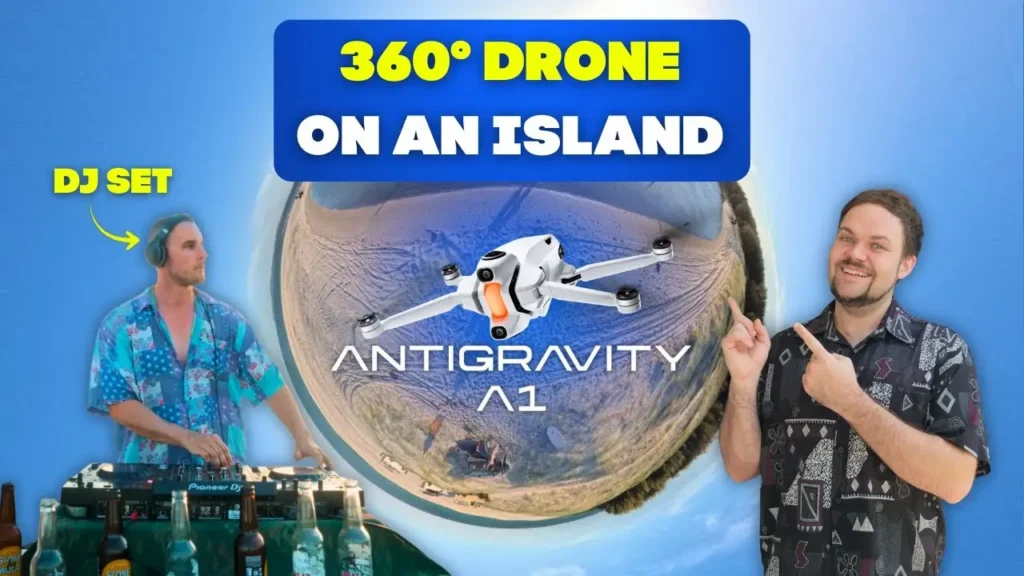
I recently traveled to a tropical island for a week, and I brought the Antigravity A1 In Action along with me. What we captured out there genuinely surprised me, because this drone captures absolutely everything. It allows you to shoot 360° 8K video and then reframe it later in post — and that alone gives you an incredible amount of peace of mind while you’re out in the field.
Knowing that I can simply fly in a direction and trust that everything is going to be in the shot is a game-changer. I can reframe it afterward, turn the video back, create a little planet effect, pull it away to get a flatter perspective — whatever I want to do, I can do it with ease in the editing stage. I don’t even have to think about composition in the moment, and that freedom completely changes how you approach a shoot.
Capturing a Live DJ Set by the Beach
The main goal I had for this trip was to capture an entire music set, as my friend was playing a DJ set right by the beach. We had his decks set up, a speaker, his camera, an Antigravity A1 In Action camera — everything was going. The drone was just that extra layer, added to capture something a little more unique and cinematic. And the Antigravity A1 really delivered that unique perspective in ways I didn’t fully anticipate.
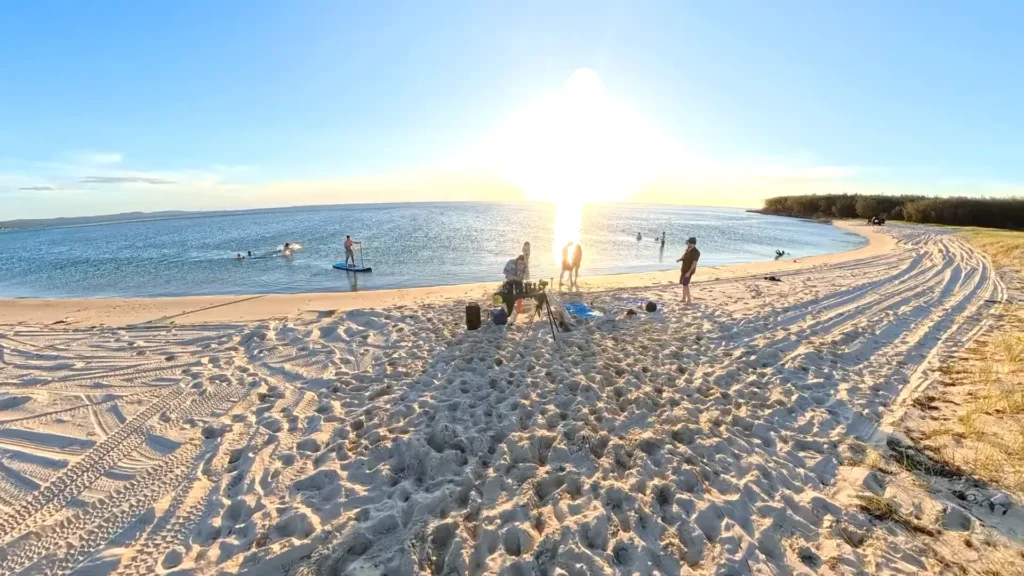
The fact that we were able to get 8K 360° drone footage to add a completely new dimension to his set genuinely elevated the whole project. My friend has been doing these beach sets every year — six years in a row now. If you want to check out the full set, head over to his YouTube channel, Creative Philosophy, where he’s uploaded the complete set along with all the footage we captured from the drone.
He’s also got the previous years available there, so you can see the evolution of what he’s been building. Each year, we try to level it up — more cameras, a new location, fresh perspectives — and this year just lined up beautifully.
Finding the Perfect Spot
We found this really cool spot right at the corner of the island. It was open ocean — literally nothing around except water stretching out in every direction, with a few islands visible in the distance and a stunning beachfront to anchor the whole scene. Then, completely out of nowhere, a bunch of random lads showed up.
They heard there was a DJ set happening, asked if they could hang out in the water, and we said absolutely — as long as everyone was comfortable with a drone flying around. They were more than happy about it.
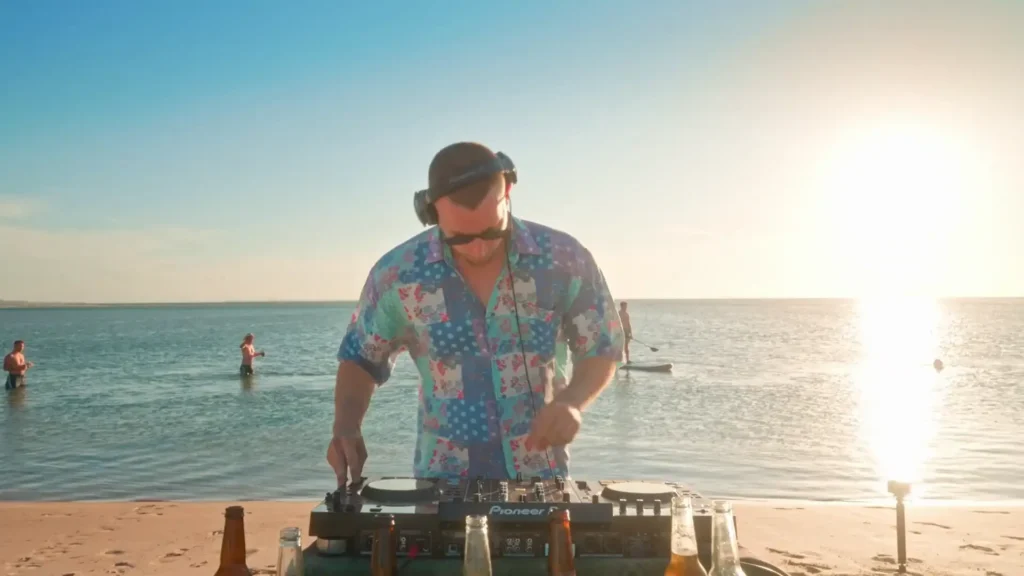
So there they were on paddle boards, drinks in hand, hanging out and having the time of their lives. We had two cameras set up on my friend Aean, and the drone was just whizzing around capturing everything.
That’s the perspective you’re seeing throughout this whole video — the full 360° experience of a live DJ set on a tropical island, with real people genuinely enjoying themselves in the moment. It was spontaneous, it was real, and the Antigravity A1 captured all of it.

The Flight Plan
My friend gave me a simple but clear brief: film constantly. Just do a continuous 30-minute or 25-minute filming session, land it, swap the batteries, and go again. Keep it smooth — nice circles around him, low shots, high shots, whatever felt right. But the 360° nature of the drone created a genuinely different kind of flight experience, and I’ll be honest — I was a little apprehensive at first.
It just feels different from any other drone I’ve flown. When you’re flying in a particular direction, it doesn’t feel the same as what I’m used to. You’re not swinging the drone around to frame your subject. In freemotion mode, I was simply flying on a path, keeping in mind that everything was going to be in shot regardless.
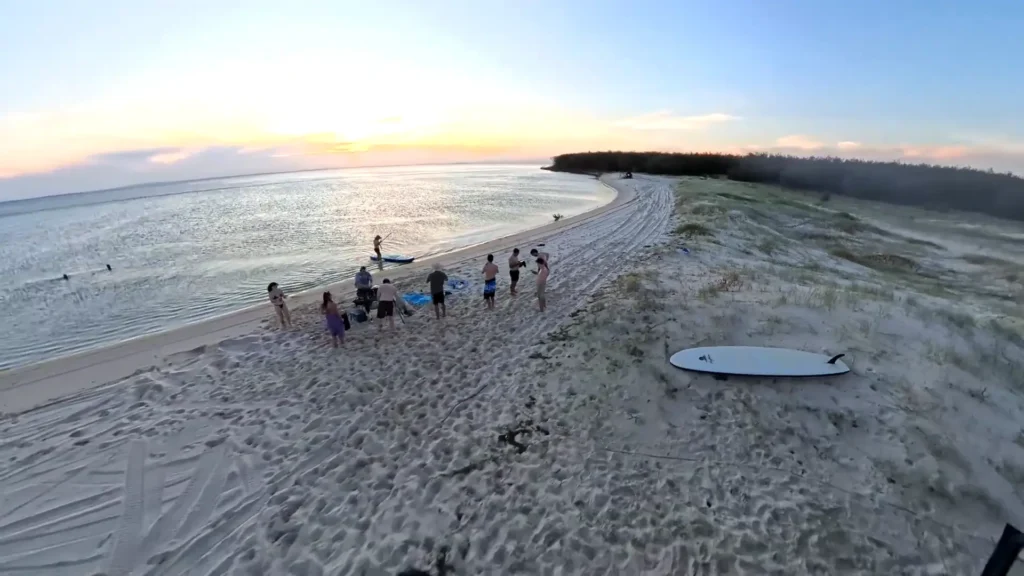
That’s what helped me get comfortable. The first couple of shots felt a little strange — just flying in and flying away without repositioning felt unnatural, because I’m so conditioned to typical drones where you’re always managing your angle relative to your subject.
But after a while, I was able to confidently commit to a flight path knowing that everything was in frame. A nice panning shot, a sweeping movement, a smooth circle, a tilting upward reveal — I could just fly and trust the camera. That shift in mindset made a huge difference, and from that point on, the whole experience just clicked.
Read More: Antigravity A1 vs DJI Avata 360
Handling Wind, Water, and Varying Light
One of the things I’m most impressed with is how the Antigravity A1 handled the conditions out there. There was wind, there was water, there was sand — a lot going on. Besides one brief moment where it dropped out for a split second and then reconnected, everything was completely fine. No issues with altitude, no issues with distance, no issues with the angles I was flying at. It just handled it all.
We also shot across multiple lighting conditions throughout the day. We had golden hour during sunset and then that lower, softer light as the sun dropped closer to the horizon. So you really get to see how the Antigravity A1 camera performs across a wide range of scenarios in this footage — from bright midday conditions all the way through to the more atmospheric, dimly lit evening shots. I love that it was able to handle all of that, and I love that the footage came out looking flawless.

The Editing Experience
Once the shooting was done, the editing process was something I was genuinely excited to explore, and it did not disappoint. Through the desktop application, you can jump into the tracking feature and simply start tracking a subject — someone on a paddle board, someone on the beach, whoever you want. No matter how the framing looks, you can track people after the fact, entirely in post. That’s an extraordinary level of creative control.
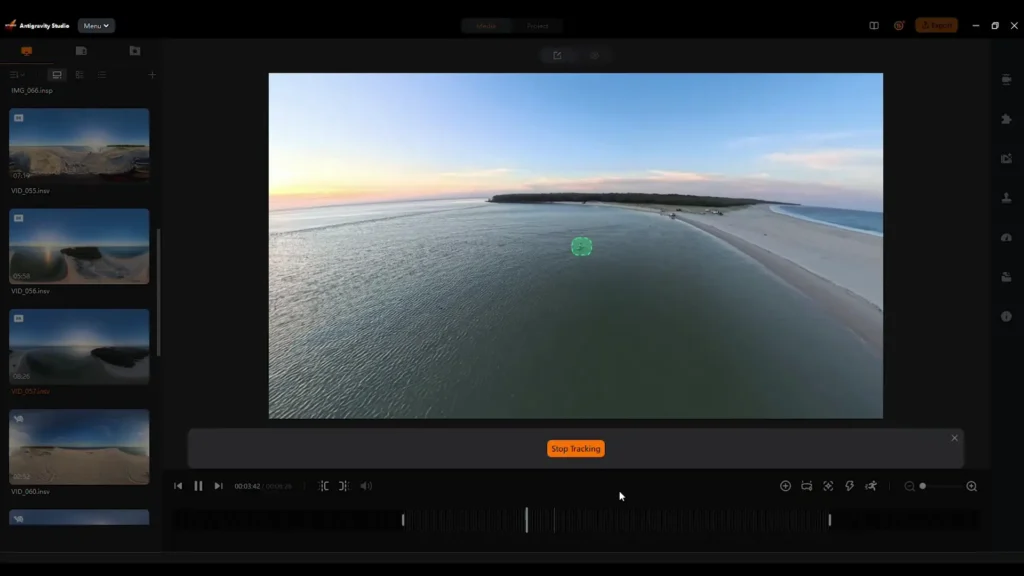
Creating that really wide, immersive perspective or that zoomed-out little planet effect is also remarkably straightforward. There are a bunch of options on the side of the editor where you can adjust brightness, contrast, and saturation, and you can apply filters as well. All of that feels natural and intuitive rather than overwhelming.
On top of that, you’ve got full control over key frames. You can set up multiple key frames and have the video perspective transition from tracking a subject, to coming around and focusing on the DJ set, to spinning out to reveal the open ocean — all of that can happen seamlessly once the key frames are set, and the editor handles those movements naturally as the video unfolds.
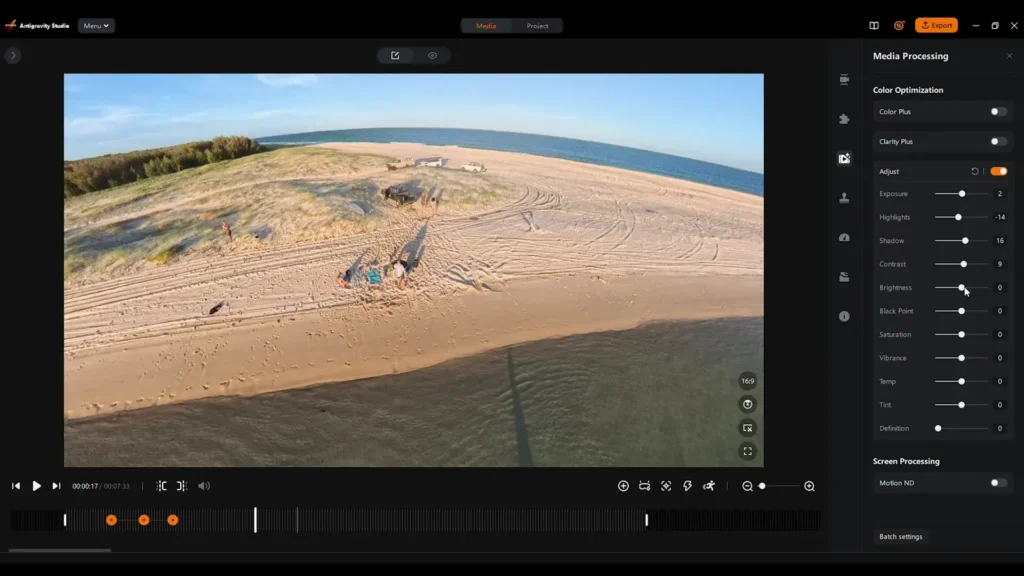
The transitions work really nicely, and the overall performance of the editing workflow has been excellent. No issues at all with the process, which is always great to see in a tool like this.
Sharing the Experience Live with the Crowd
One of the most memorable parts of the whole day wasn’t even about the footage itself — it was about sharing the experience in real time. With the goggles on, I could invite people over and just say, “Hey, have a look at this.” A couple of times I handed the headset across to people while I kept hold of the controller, and watching their reactions was genuinely brilliant.
People were blown away — the idea that they could look around, look down, and see the world from that perspective while standing on the beach was something they’d never experienced before. That was just so cool, and it made the whole thing feel like so much more than a production shoot.
Read More: Antigravity A1 Early Review
Getting Comfortable with a Different Kind of Drone
I want to be transparent about the learning curve, because I think it’s worth talking about. The control experience with the Antigravity A1 does feel different — even compared to other drones with motion controllers, it just has its own feel that takes a bit of getting used to. At first, I kept thinking the way I normally would: if that’s my subject, I need to position and angle the drone to keep it in frame at all times. But that logic doesn’t apply here in the same way.
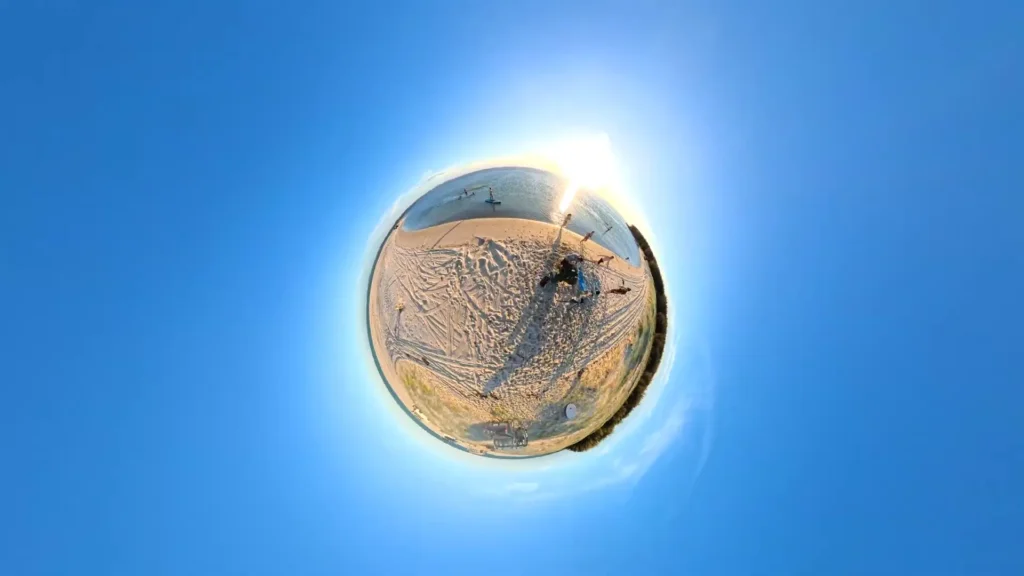
Once I let go of that habit and leaned into the freedom the drone offers — knowing I can fly in any direction and still get the shot because I can move the camera and key frame it and track whatever I need in post — everything became much more fluid. That peace of mind is really the core of what makes the Antigravity A1 so different. You’re not chasing the shot in the air. You’re creating it on the ground afterward, with total control.

A Memory That’s Baked In
Looking back on the whole day, what strikes me most is how special it was as a lived experience, not just a production. Random people showed up, joined the vibe, paddled around in the ocean, and had a genuinely amazing time — and we captured all of it. The whole project is there to watch if you want the full picture, and this video is really just distilling the story of what happened that day.
The Antigravity A1 made it possible to capture a live, spontaneous, beautiful moment in its entirety — and to do so without being so deep in technical execution mode that you miss the experience itself. That balance is rare, and it’s what I’ll remember most from this trip.
Table of Contents
Read More: DJI Neo 2 Wind Test