
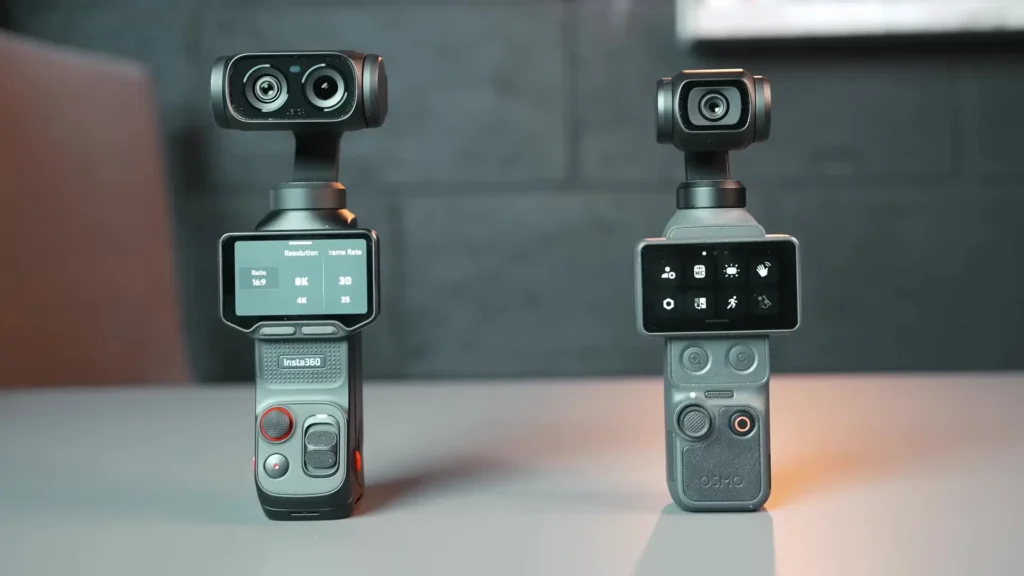
In the battle of pocket cameras, two serious contenders have stepped into the ring: the DJI Pocket 4 and the brand-new Insta360 Luna Ultra. DJI released the Pocket 4 in April 2026, and Insta360 has just launched their first-ever pocket camera, the Luna Ultra. With both cameras gaining massive popularity among travel vloggers and content creators, the big question is simple: which one should you get?
This article covers side-by-side comparisons, features, specs, and a final verdict to help you make the right choice. There is a lot to get through, so let’s dive straight in.
Table of Contents
Why Pocket Cameras Are So Popular Right Now
What makes cameras like these so appealing is the form factor. You get a camera that is literally palm-sized, fits easily in your pocket, and delivers a quality that is absolutely remarkable. This is exactly why they have become the go-to choice for vloggers, content creators, and travelers alike.
If you want a camera to take on a trip or vacation without carrying a big, bulky body with multiple lenses, you can take just one of these and still get fantastic results. The convenience factor alone makes them incredibly attractive, but the real story is how capable they actually are.
Size, Weight, and Build
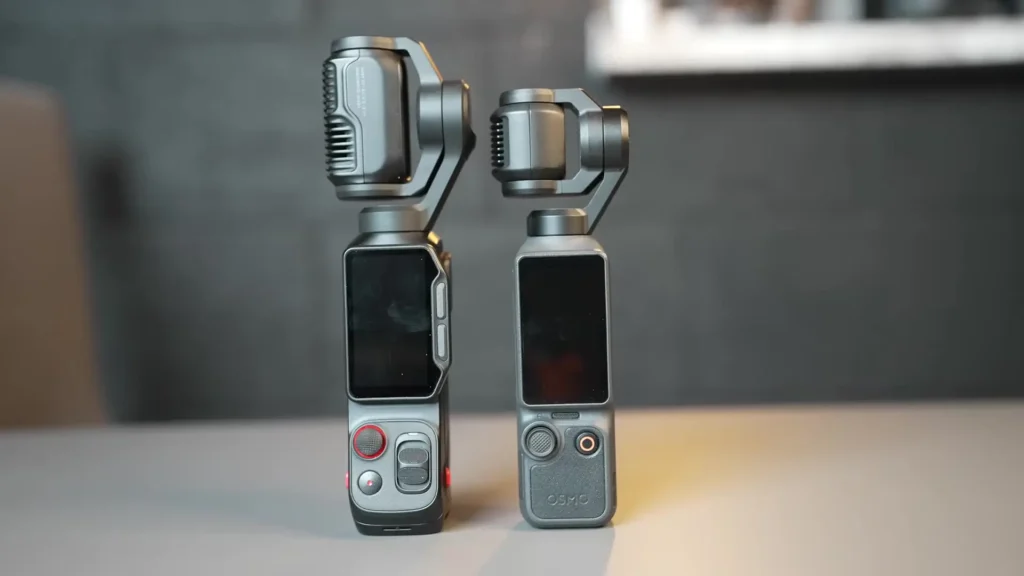
The Luna Ultra is heavier than the DJI Pocket 4, coming in at 233g compared to 190.5g on the Pocket 4. It is also a bit taller and slightly wider. That extra weight comes down to the dual lens camera system sitting on top of the Luna Ultra. However, both cameras feel really nice to hold, and neither will have your arm aching after a few minutes of use.
Specs and Sensor Comparison
The spec sheet on both of these cameras is truly impressive. The DJI Pocket 4 features a 1-inch CMOS sensor with an F2, 20mm lens. It can shoot up to 4K60 for standard video and an impressive 4K240 FPS for slow motion. Both cameras are 10-bit capable, which is a shared strength worth noting.
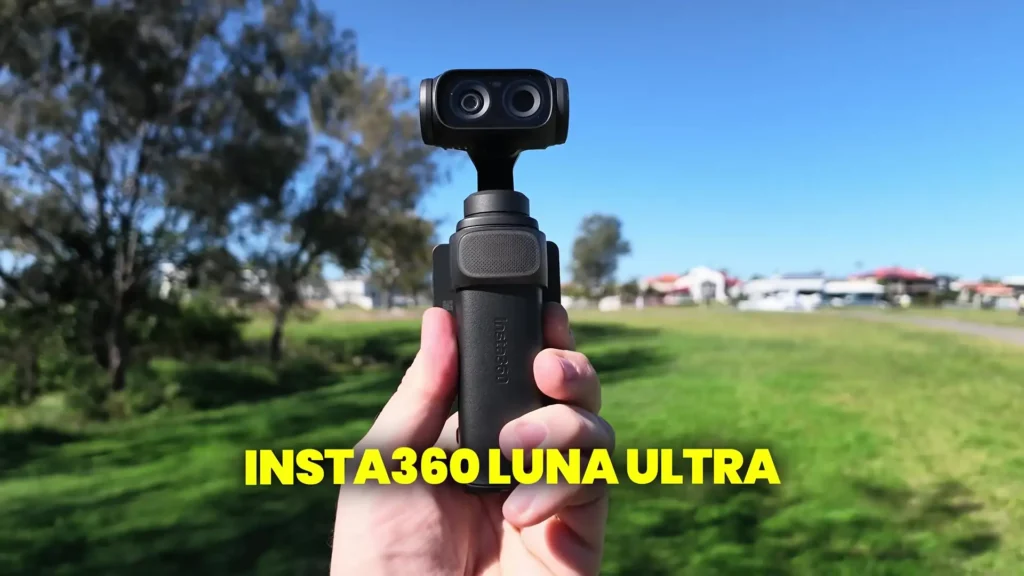
The Insta360 Luna Ultra takes things further with a dual lens setup. The main lens is a 1-inch sensor shooting up to 8K30 FPS with Dolby Vision support and 4K120 for slow motion. It also has a slightly wider aperture at F1.8 on that same 20mm focal length.
On the main lens, both cameras are closely matched. However, the biggest advantage the Luna Ultra holds is the ability to shoot in 8K up to 30 FPS, while the Pocket 4 maxes out at 4K. That is a meaningful difference if you want the option to crop in post or future-proof your footage.


Video Quality
Looking at direct out-of-camera footage converted to Rec. 709, with no extra LUTs applied, both cameras look absolutely fantastic. It is genuinely hard to pick a clear winner based on image quality alone. The dynamic range on both is very similar. Highlights, shadows, and overall color rendering all look natural and pleasing on each camera.
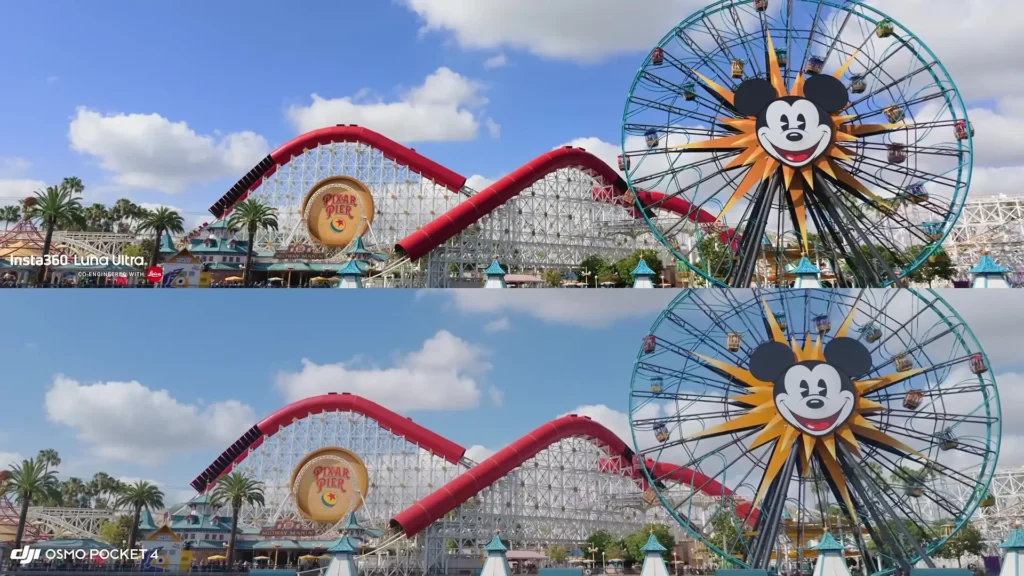
It really comes down to personal preference and which color science appeals to you more. But for content creation, vlogging, or holiday footage, either of these cameras will deliver stunning results. The 20mm focal length paired with gimbal stabilization makes them ideal for handheld vlogging, and the stabilization is among the best you can possibly get in a camera this size.
Zoom and Telephoto Capabilities
This is where the gap between the two cameras becomes very clear. The DJI Pocket 4 has a single lens with a two times crop option, giving you a 40mm focal length.
You can zoom in further up to four times digitally, but that is simply a digital crop and falls apart quickly unless you are shooting in very bright conditions. Going from 20mm to 40mm is not a dramatic change, and honestly, many users will find themselves rarely reaching for that zoom option.
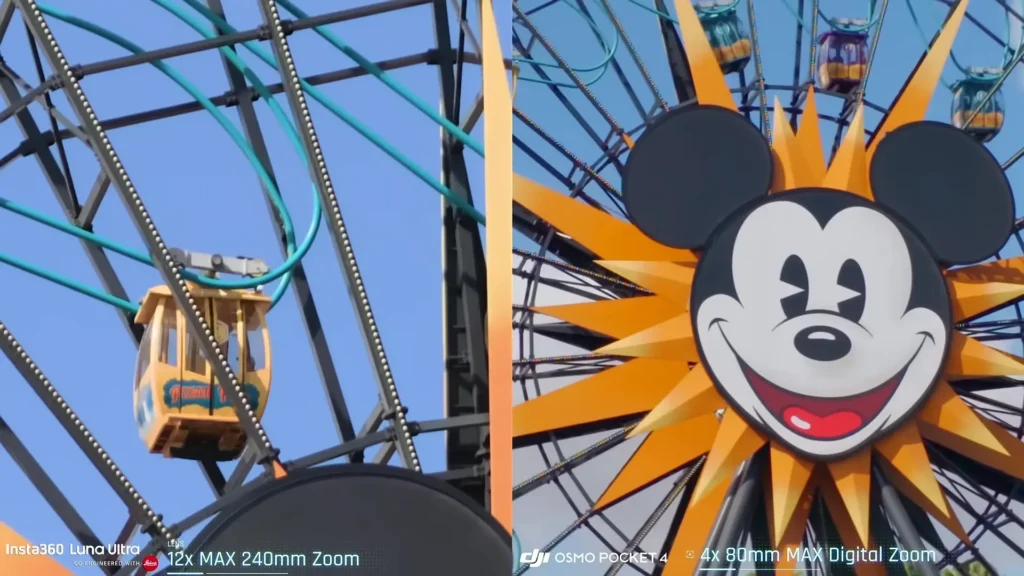
The Insta360 Luna Ultra, on the other hand, has a dedicated telephoto lens with an F2 aperture and a 1/1.3-inch sensor. That tele lens offers a three times optical zoom at 60mm equivalent, a six times lossless zoom at 120mm, and you can push all the way out to 240mm with digital zoom. This lens can still shoot in 8K30, 10-bit log video.
Having a 20mm to 240mm range on a camera this small is remarkable. The Luna Ultra has a massive advantage here, and if zoom versatility matters to you, this is a significant deciding factor.
Low-Light Performance
Both cameras deliver strong low-light video capabilities. The DJI Pocket 4 can film up to 4K30 in low-light mode, while the Luna Ultra supports 4K60 in its pure video mode under similar conditions.
In-camera processing automatically boosts highlights, applies noise reduction, and adds some sharpness, but without going overboard. The results on both cameras look natural and genuinely impressive. You can shoot confidently in daytime and low-light conditions with either of these, and the footage holds up well.
Also Read: Insta360 Luna Ultra Review
Vertical Video
Vertical video is incredibly popular right now, and both cameras can shoot in that format. Neither gimbal rotates into a dedicated vertical mode, so both cameras crop in to around 3K60 for vertical shooting. You still have access to D-Log and I-Log color profiles and 10-bit video in this mode, which is more than adequate for Instagram or TikTok content.
If you want the highest quality vertical video possible, you can rotate either camera horizontally and shoot that way. On the Luna Ultra, when you rotate the camera, the screen automatically adjusts its ratio to vertical mode, giving you 8K30 FPS in a vertical orientation.
On the DJI Pocket 4, the screen does not automatically adjust when rotated, making the experience a little less intuitive, but vertical video capture is still possible.
Wireless Control and the Detachable Screen
Both cameras can be controlled wirelessly through their dedicated apps, the Insta360 app and the DJI Mimo app. However, the Luna Ultra has a feature that genuinely stands out.
The front screen of the Luna Ultra detaches completely. Once removed, you can remotely rotate the camera, control the zoom, and monitor your shot through the OLED screen in your hand.
But it goes even further than that because the detachable screen also has a built-in microphone. This means you can mount the camera at a distance, such as on a suction cup at the front of a car, walk away, and still capture your audio through that detached screen while the camera films from a completely different position.
When you are done, you simply clip the screen back on and you are back in standard camera mode. This is a genuinely clever design idea that the DJI Pocket 4 simply does not offer, as its front screen does not detach.
Battery Life and Charging
Both cameras deliver solid battery life in real-world use. While official specs tend to be measured under ideal conditions like 1080p in perfect lighting, in practice both cameras deliver around 2 to 3 hours of use, which is very workable for a day out filming.
Both cameras also support fast charging. The DJI Pocket 4 can go from zero to 80% in 18 minutes, and the Luna Ultra does the same in around 20 minutes. A practical workflow is to film for a while, take a break for coffee or food, charge up via a power bank during that time, and then be back to 80% and ready to go again before you even finish your break.
Custom Buttons and Controls
Both cameras come with custom buttons to speed up your workflow. On the DJI Pocket 4, there is a zoom button and a custom button just beneath the screen. A single tap on the custom button automatically rotates the gimbal for a selfie-style vlog shot, and the zoom button jumps to the two times crop.
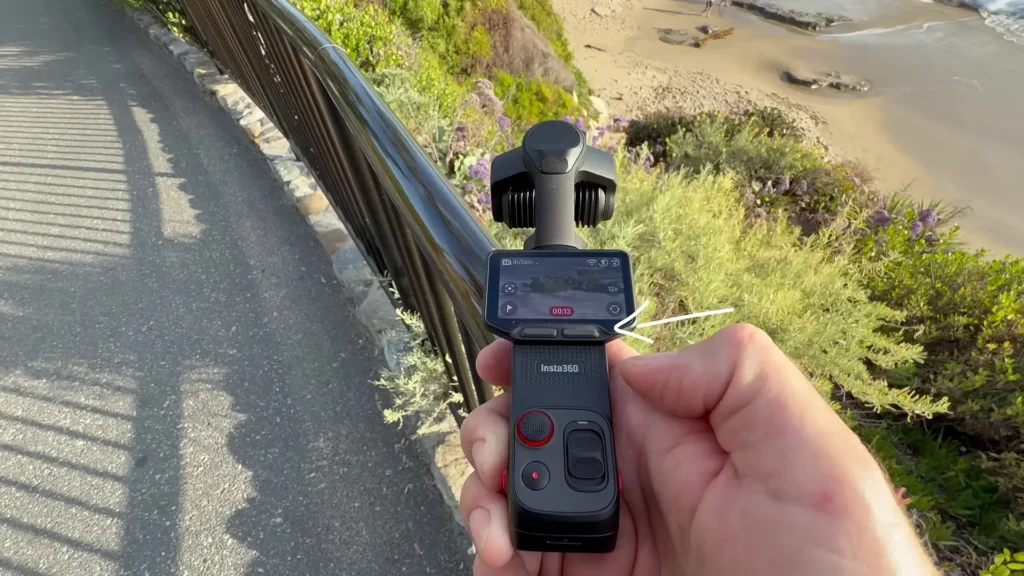
The Luna Ultra offers two customizable buttons on the screen, and you can assign them however you like. One can be set to rotate the gimbal, and the other can be configured to zoom in up to 12 times with a single press.
One notable difference is in vertical shooting mode. On the Luna Ultra, you retain access to those custom buttons thanks to the design of the camera. On the DJI Pocket 4, due to the way the camera is designed, those customization buttons become inaccessible when shooting in vertical mode.
Photo Quality
While both cameras are primarily video tools, they are both capable of taking some genuinely impressive photos. The DJI Pocket 4 captures 37 megapixel stills, and the Luna Ultra matches that with 37 megapixels as well. The fast apertures on both cameras allow for high-detail shots with excellent dynamic range.


The Luna Ultra again holds an advantage for photography too, since you can use the dedicated three times and six times telephoto lens for stills as well, giving you much more versatility when capturing subjects at a distance.
Subject Tracking
Tracking on both of these cameras is outstanding and among the best available in any camera at this size. The Luna Ultra uses Deep Track technology. You simply tap a button once, the camera identifies a subject, and it begins tracking automatically.
This works brilliantly for fast-moving objects, people, and even for keeping yourself centered in the frame. You could place this camera on a tripod, wear a wireless microphone, walk around freely, and the camera will continuously rotate and keep you in the shot.
The DJI Pocket 4 uses Active Track, which works in a very similar way. A double tap on the screen enables tracking, and the camera will then rotate to keep your subject centered no matter where they move.
Tracking cars is another great use case on both cameras. With the Pocket 4, you can track a subject up to 40mm. On the Luna Ultra, you can track up to 12 times zoom or 240mm, which opens up entirely different creative possibilities. Both systems perform exceptionally well for vlogging and content creation.
Creative Color Profiles
Because the Luna Ultra is co-engineered with Leica, it offers three dedicated Leica color profiles that give your footage that signature Leica look directly in camera, without any color grading required. This is a genuinely appealing feature for creators who want a distinctive cinematic style straight out of the box.
The DJI Pocket 4 counters with its own film tones, which mimic the popular Fujifilm looks. These give you a range of filmic styles and color grades that can be applied in camera for a finished look without post-processing. Both cameras offer solid creative options in this department, and it again comes down to personal preference.
Price, Packaging, and Accessories
There is a price difference between the two cameras, and what you are paying extra for on the Luna Ultra is primarily that outstanding telephoto lens. Whether that justifies the additional cost will depend on how important zoom versatility is to your shooting style.
One practical concern worth raising is availability. If you live in the United States, getting hold of the DJI Pocket 4 may actually prove to be a challenge, which is something to factor into your decision.
On the accessories and packaging front, both cameras come with bags for storing accessories, but the experience differs meaningfully. The DJI Pocket 4 comes with a basic pouch that feels cheap and leaves ND filters and accessories loose inside. It does not offer the same level of protection that the DJI Pocket 3’s case provided, and it feels like a step backwards in that regard.
The Luna Ultra, by contrast, comes with a really nice rigid protective case. You slot the camera in, it feels secure, and when you open it up you are ready to shoot. It inspires a lot more confidence that your camera will arrive at your destination without scratches or damage.
Comparison Table: DJI Pocket 4 vs Insta360 Luna Ultra
| Feature | DJI Pocket 4 | Insta360 Luna Ultra |
|---|---|---|
| Sensor (Main) | 1-inch CMOS | 1-inch CMOS |
| Aperture (Main) | F2 | F1.8 |
| Focal Length (Main) | 20mm | 20mm |
| Max Video Resolution | 4K60 | 8K30 |
| Slow Motion | 4K240 FPS | 4K120 FPS |
| 10-Bit Video | Yes | Yes |
| Dolby Vision | No | Yes |
| Telephoto Lens | No (Digital Crop Only) | Yes (Dedicated Lens) |
| Max Optical Zoom | 40mm (2x Crop) | 120mm (6x Lossless) |
| Max Digital Zoom | 4x | 12x (240mm) |
| Low-Light Mode | 4K30 | 4K60 |
| Photo Resolution | 37 MP | 37 MP |
| Weight | 190.5g | 233g |
| Detachable Screen | No | Yes (with Built-in Mic) |
| Subject Tracking | Active Track | Deep Track |
| Vertical Video | Yes (Cropped to 3K60) | Yes (8K30 Rotated) |
| Fast Charging (0-80%) | 18 Minutes | 20 Minutes |
| Color Profiles | Fujifilm Film Tones | Leica Color Profiles |
| Protective Case | Basic Pouch | Rigid Protective Case |
| Custom Buttons in Vertical | No | Yes |
Final Verdict: DJI Pocket 4 vs Insta360 Luna Ultra
Both cameras are genuinely fantastic. To get this level of quality from something that fits in your palm is remarkable, and neither of these cameras is a bad choice. They are both brilliant tools for vlogging, content creation, and travel.
However, if a choice has to be made, the Insta360 Luna Ultra pulls ahead for most users. The 20mm to 240mm focal range in a package this compact is extraordinary. The detachable screen with a built-in microphone is a genuinely innovative feature. The software is impressive, the colors are pleasing, battery life is strong, and the build quality feels premium. For travel, creative content, and versatility, the Luna Ultra simply offers more.
The DJI Pocket 4 is still an excellent camera, particularly if the 20mm to 40mm range suits your shooting style, or if you prefer the DJI ecosystem and its color science. But the telephoto limitation and the less inspiring accessories packaging hold it back slightly when compared directly to what the Luna Ultra brings to the table.
Read More: DJI Osmo Mobile 8P Review & Tested