
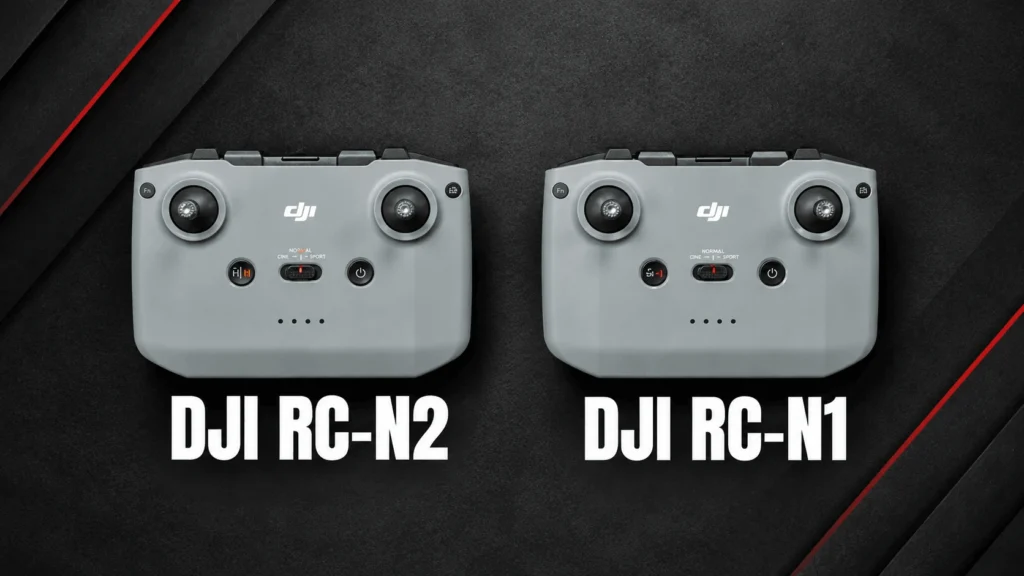
If you’ve been comparing DJI drone bundles or looking at replacement controllers, you’ve probably noticed two very similar-looking remotes: the RC-N1 and the RC-N2. At a glance they’re nearly identical, same general shape, no built-in screen, same phone-tethered design. But under the hood, DJI RC-N1 vs RC-N2 is actually a meaningful generational jump, one built around an older video transmission standard, the other built specifically to unlock DJI’s newer O4 system.
This guide breaks down exactly what changed between the two controllers, which drones each one actually supports, and how to know which one you need, so you don’t end up buying a remote that can’t talk to your drone at full capability.
Quick Answer
The DJI RC-N1 is the older of the two controllers, supporting DJI’s OcuSync 2.0 (O2), O3, and O3+ video transmission systems, and it’s compatible with a wide range of older DJI drones from the Mini 2 through the Mavic 3 Pro.
The RC-N2 is its direct successor, launched alongside the DJI Air 3, and its main upgrade is support for DJI’s newer O4 transmission system, along with an upgraded 2T2R antenna array (versus the RC-N1’s 1T2R) that extends real-world range and improves connection stability.
In the DJI RC-N1 vs RC-N2 comparison, the deciding factor is almost always your drone: if your drone requires O4 transmission, you need the RC-N2, the RC-N1 simply isn’t compatible with it. If you own an older O2/O3-era drone, the RC-N1 remains a perfectly capable, typically cheaper option.
DJI RC-N1 vs RC-N2: Full Specification Comparison
| Specification | DJI RC-N1 | DJI RC-N2 |
| Also known as | RC231 | RC-N2 |
| Video transmission | OcuSync 2.0 (O2), O3, O3+ | O3, O4 |
| Antenna configuration | 1T2R | 2T2R |
| Max range | Up to 10km (varies by paired drone and region) | Up to 20km (FCC) / 10km (CE) |
| Extra frequency band | No | Yes, additional 5.1GHz band supported in Europe |
| Built-in screen | No, requires a tethered smartphone | No, requires a tethered smartphone |
| Companion app | DJI Fly | DJI Fly |
| Launched alongside | DJI Mini 2 | DJI Air 3 |
| Compatible drones | Mini 2, Mini 2 SE, Mini 3, Mini 3 Pro, Mini 4K, Mavic Air 2, Air 2S, Mavic 3, Mavic 3 Classic, Mavic 3 Pro | Mini 4 Pro, Air 3 |
| Typical price | Generally the cheaper of the two | Generally priced higher than the RC-N1 |
What Is the DJI RC-N1?
The RC-N1, sometimes labeled RC231 on DJI’s own documentation, was introduced alongside the DJI Mini 2 and quickly became DJI’s standard, no-frills controller for the years that followed.
It supports DJI’s OcuSync 2.0, O3, and O3+ video transmission systems, depending on which drone it’s paired with, and because of that broad support, it ended up compatible with an unusually wide range of drones released across several product generations: the Mini 2, Mini 2 SE, Mini 3, Mini 3 Pro, Mini 4K, Mavic Air 2, Air 2S, Mavic 3, Mavic 3 Classic, and Mavic 3 Pro.
It has no built-in screen. Flying with the RC-N1 means clipping your smartphone into its top-mounted cradle and running the DJI Fly app for your live video feed and settings, which keeps the controller itself lightweight and relatively affordable.
What Is the DJI RC-N2?
The RC-N2 arrived with the launch of the DJI Air 3, and its entire purpose was to bring DJI’s newer O4 video transmission system to the standard, non-smart controller lineup. Visually, DJI kept the RC-N2 nearly identical to the RC-N1, similar shape, similar layout, no built-in screen, but the changes underneath are substantial.
The antenna configuration was upgraded from 1T2R to 2T2R, giving it a real-world range advantage of up to roughly 20km under FCC regulations (10km under CE), and it added support for an extra 5.1GHz frequency band in European markets, improving connection stability in congested RF environments.As of now, the RC-N2 is confirmed compatible with the DJI Mini 4 Pro and DJI Air 3.
Video Transmission: The Core Difference
This is the single most important distinction in the DJI RC-N1 vs RC-N2 comparison, and it’s the reason the two controllers aren’t interchangeable. The RC-N1 tops out at O3+ support and has no ability to communicate with a drone running DJI’s O4 transmission system. The RC-N2 was built specifically to add that O4 support, alongside continued backward compatibility with O3.
In practical terms: if you own a drone that requires O4 (such as the Mini 4 Pro or Air 3), the RC-N1 will not work with it at all, regardless of firmware updates. This isn’t a settings issue or a compatibility toggle; it’s a hardware limitation baked into the RC-N1’s radio.
Range and Antenna Improvements
The jump from a 1T2R to a 2T2R antenna array on the RC-N2 isn’t just a marketing spec bump, it translates into a genuinely longer maximum range (up to 20km under FCC rules, versus the RC-N1’s roughly 10km ceiling) and a more stable connection overall, particularly in areas with more radio interference.
For most casual flyers who rarely push a drone anywhere near its maximum range, this difference won’t be noticeable day-to-day. But for anyone flying in busier RF environments, near cities, other wireless devices, or crowded flying fields, the RC-N2’s improved antenna setup provides real, tangible benefit.
Design and Ease of Use
DJI deliberately kept the RC-N2’s physical design close to the RC-N1’s, similar size, similar button layout, no built-in display on either. Both require a tethered smartphone running the DJI Fly app to see your live video feed and adjust settings, so neither controller offers the standalone convenience of DJI’s screen-equipped “smart” controllers like the RC 2. If you’re comparing these two purely on ergonomics and day-to-day usability, they feel almost identical to hold and fly with, the real differences live entirely in what’s happening on the radio side.
Which Drones Does Each Controller Support?
DJI RC-N1 compatible drones: Mini 2, Mini 2 SE, Mini 3, Mini 3 Pro, Mini 4K, Mavic Air 2, Air 2S, Mavic 3, Mavic 3 Classic, Mavic 3 Pro.
DJI RC-N2 compatible drones: Mini 4 Pro, Air 3.
Notice how much narrower the RC-N2’s officially confirmed compatibility list is. That’s not a flaw, it’s simply a newer controller matched to DJI’s newer O4-equipped drones, while the RC-N1 accumulated a longer compatibility list over several years and multiple drone generations.
Price Considerations
The RC-N1, being the older and simpler of the two, is generally the cheaper option, and it’s often found bundled with older drone packages or sold individually at a lower price point than the RC-N2. The RC-N2 typically commands a higher price, reflecting its newer transmission hardware and upgraded antenna system.
If you already own a drone that only needs O2 or O3, there’s no practical benefit to paying more for an RC-N2 you can’t fully utilize; conversely, if your drone requires O4, the RC-N1’s lower price doesn’t matter since it simply won’t work.
Which Should You Buy?
The honest answer in the DJI RC-N1 vs RC-N2 decision comes down almost entirely to which drone you own or plan to buy, not personal preference. If your drone is a Mini 4 Pro, Air 3, or any other O4-equipped model, you need the RC-N2, there’s no alternative that gives you full functionality.
If your drone is one of the RC-N1’s supported models, from the Mini 2 through the Mavic 3 Pro, the RC-N1 remains a completely capable, typically less expensive choice, and upgrading to the RC-N2 would offer no meaningful benefit since your drone can’t use O4 transmission anyway.
Frequently Asked Questions
Is the DJI RC-N2 backward compatible with RC-N1 drones?
Partially. The RC-N2 supports O3 transmission, so it can work with some drones that also work with the RC-N1, but always check DJI’s specific compatibility list for your drone model before assuming it will work, since not every RC-N1-compatible drone has been confirmed to pair with the RC-N2.
Can I use the DJI RC-N1 with a drone that requires O4?
No. The RC-N1’s radio hardware does not support O4 transmission at all. Drones like the Mini 4 Pro and Air 3 require the RC-N2 (or another O4-compatible controller) to function.
Does the DJI RC-N2 have a built-in screen?
No. Like the RC-N1, the RC-N2 requires a tethered smartphone running the DJI Fly app to display your live video feed and access flight settings.
What is the range difference between DJI RC-N1 and RC-N2?
The RC-N1 typically reaches up to around 10km under ideal conditions, while the RC-N2’s upgraded 2T2R antenna extends that to up to roughly 20km under FCC regulations (10km under CE regulations in Europe).
Is the DJI RC-N2 worth the extra cost over the RC-N1?
Only if your drone requires O4 transmission or you specifically want the RC-N2’s extended range and improved antenna stability. If your drone only supports O2 or O3, the RC-N1 delivers the same core functionality at a lower price.
Read More: DJI FPV RC 3 vs ELRS Controller: Which Is Best for FPV?