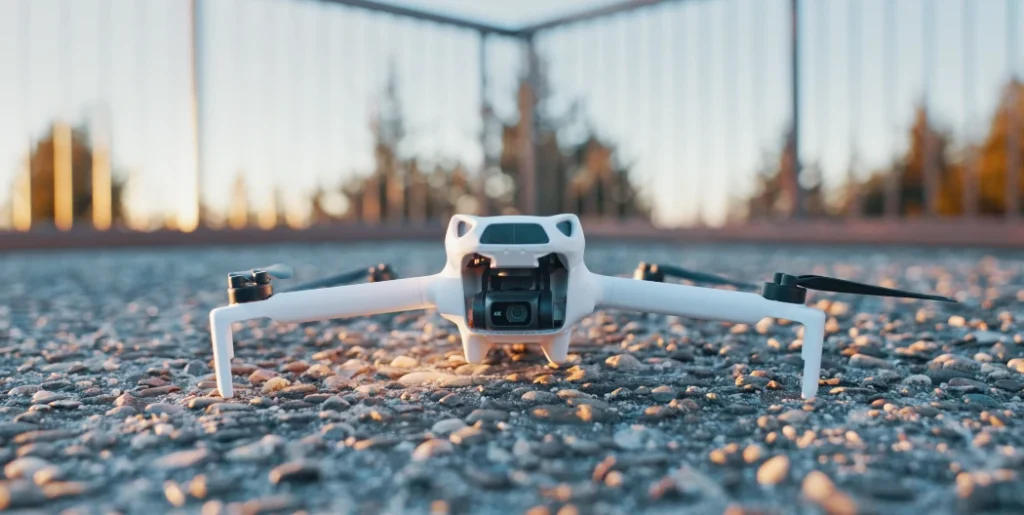

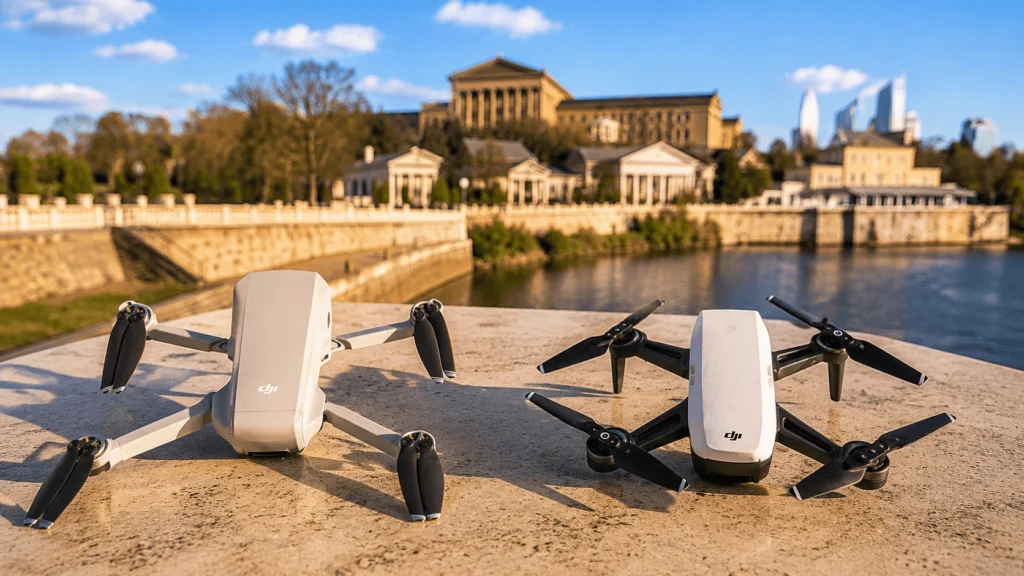
DJI’s release of the Mavic Mini has introduced a genuine dilemma for existing DJI Spark owners. Both drones occupy the ultralight category and share substantial overlap in intended use, portability, and price positioning, yet they diverge meaningfully in weight classification, camera performance, flight endurance, and feature set.
This comparison evaluates both drones across every category that matters to a purchasing decision: weight and regulatory classification, portability, camera and video performance, flight time, transmission range, gimbal stabilization, app and software experience, connection reliability, obstacle avoidance, intelligent flight modes, and overall usability, to give Spark owners a clear, evidence-based answer on whether upgrading is actually worthwhile.
Table of Contents
Weight and Regulatory Classification
The Mavic Mini weighs 249 grams, while the DJI Spark weighs 300 grams, a 51-gram difference that carries outsized practical significance. In many countries, 250 grams is the regulatory threshold: drones at or above that weight require registration, while drones below it do not. The Mavic Mini’s weight places it just under that line, meaning owners in many jurisdictions can fly it without the registration process the Spark requires.
This single distinction is arguably the most consequential difference in this comparison for pilots who fly recreationally and want to minimize regulatory friction.

Size and Portability
Folded, the Mavic Mini is marginally more compact than the Spark, a result of the Spark’s arms not folding flat against the body. Unfolded, however, the Mavic Mini is slightly larger than the Spark. The difference in either state is minor and unlikely to meaningfully affect a packing decision.
Camera and Video Performance
This is the category where the Mavic Mini distinguishes itself most clearly. The Mavic Mini records video at 2.7K, while the Spark is limited to 1080p. At 1080p, the Mavic Mini also supports both 30fps and 60fps, while the Spark supports 30fps only.
Bitrate tells a similar story: the Mavic Mini encodes at 40 Mbps versus the Spark’s 24 Mbps, a difference that translates directly into cleaner, more detailed footage with fewer compression artifacts. The tradeoff is larger file sizes, a relevant consideration for pilots managing limited storage or slower upload workflows.
On camera performance alone, the Mavic Mini represents a clear and measurable upgrade over the Spark.

Flight Time
- Spark: 16 minutes (rated)
- Mavic Mini: 30 minutes (rated)
Both figures reflect ideal test conditions and will be lower in real-world flying. Even accounting for that gap, the Mavic Mini’s rated flight time is nearly double the Spark’s, representing one of the most significant practical improvements in this comparison. For pilots who have found 16 minutes of flight time consistently limiting, this upgrade alone may justify the switch.
Transmission Range
- Spark (with remote): 2 km
- Mavic Mini: 4 km
As with flight time, real-world transmission distances will fall short of the rated figures for both drones. The Mavic Mini’s rated range is double the Spark’s, giving it a clear theoretical advantage, though most pilots are unlikely to approach the outer limits of either drone’s range in typical flying conditions.
It is also worth noting that while the DJI Spark originally required a Wi-Fi connection between phone and controller, DJI later added official OTG cable support through a firmware update, closing what was previously a gap between the two drones on this front.
Gimbal Stabilization
The Mavic Mini is equipped with a 3-axis gimbal, an upgrade over the Spark’s 2-axis gimbal. The Spark’s 2-axis system already produced smooth footage in practice, so this upgrade is incremental rather than transformative, but it does give the Mavic Mini a stability advantage on paper and in especially demanding shooting conditions.
App and Software Experience
The Mavic Mini pairs with a new application, DJI Fly, which replaces the DJI GO 4 app used by the Spark. DJI Fly is a deliberately simplified interface: it includes a larger viewing area and a built-in feature for discovering filming locations, and it is considerably easier to navigate for pilots who found DJI GO 4’s menu structure overwhelming.
The tradeoff is a reduction in available advanced settings. Pilots who prefer granular control over their flight parameters may find DJI Fly comparatively limited. It should also be noted that DJI Fly was still in beta at the time of testing, with an official release reportedly scheduled for the 11th, so aspects of the app experience may change.
Connection Reliability
Based on extended flying with both drones, the Spark’s connection to its remote proved slightly more stable than the Mavic Mini’s, with fewer disconnects and a smoother video feed overall. Both drones operate over Wi-Fi, but the Spark currently holds a modest edge in consistency.
Obstacle Avoidance
The DJI Spark includes basic forward-facing obstacle avoidance, providing a warning to the pilot before a collision. The Mavic Mini does not include this feature at all. Both drones retain bottom-facing positioning sensors for altitude assistance when GPS is unavailable, so this distinction applies specifically to forward obstacle detection.
For pilots flying in cluttered environments or those who rely on this safety margin, the absence of obstacle avoidance on the Mavic Mini is a meaningful regression, not a minor omission.
Intelligent Flight Modes
This category represents one of the more substantial losses for pilots considering the upgrade. The Spark supports ActiveTrack, allowing the drone to autonomously follow a subject, along with additional modes such as TapFly. The Mavic Mini supports only a limited set of basic flight modes and does not include ActiveTrack or TapFly at all.
Pilots who regularly use these features to capture subject-tracking footage will find this a genuine functional downgrade, not simply a difference in polish.
Additional Functionality Differences
Several smaller but meaningful differences also favour the Spark:
- Goggles compatibility: The Spark can be flown using DJI goggles. The Mavic Mini cannot, at least as of testing, though this may change with a future firmware update.
- Phone-only piloting: The Spark can be flown using just a smartphone, with no controller required, a genuine convenience for minimalist packing. The Mavic Mini requires the physical remote controller at all times.
- Visibility in low light: The Spark’s bright LEDs remain visible at altitude in darker conditions. The Mavic Mini has a single small LED near the rear that becomes difficult to see once the drone climbs beyond 20 to 30 feet.
- Propeller replacement: The Spark uses twist-and-lock propellers that can be swapped in seconds. The Mavic Mini’s propellers are secured with small screws, requiring more time and tools to replace in the field, a relevant drawback after a crash or collision.
DJI Spark vs Mavic Mini: Specifications
| Feature | DJI Spark | DJI Mavic Mini |
| Weight | 300g | 249g |
| Registration Required (typical) | Yes, in most countries | No, in most countries |
| Max Video Resolution | 1080p | 2.7K |
| Frame Rates | 1080p at 30fps | 1080p at 30fps and 60fps |
| Bitrate | 24 Mbps | 40 Mbps |
| Gimbal | 2-axis | 3-axis |
| Max Flight Time (rated) | 16 minutes | 30 minutes |
| Max Transmission Range | 2 km (with remote) | 4 km |
| Flight App | DJI GO 4 | DJI Fly |
| Obstacle Avoidance | Basic forward sensors | None |
| ActiveTrack | Yes | No |
| TapFly | Yes | No |
| Gesture Control | Yes | No |
| Goggles Compatibility | Yes | No (at time of testing) |
| Phone-Only Piloting | Yes | No, controller required |
| Visible LEDs | Bright, visible at altitude | Single small LED, hard to see at altitude |
| Propeller Design | Twist-and-lock | Screw-mounted |
Final Verdict
The Mavic Mini and the Spark each win decisively in different categories, and neither drone is a strict upgrade over the other. The Mavic Mini wins comprehensively on camera quality, flight time, transmission range, gimbal stabilization, and regulatory weight classification. These are substantial, measurable improvements that will matter to most pilots.
The DJI Spark, however, retains real advantages that the Mavic Mini simply does not match: forward obstacle avoidance, intelligent flight modes including ActiveTrack, phone-only operation, goggles compatibility, better low-light visibility, and faster propeller changes. For pilots who actively use these features, the Mavic Mini’s upgrades do not offset what would be lost in the switch.
For pilots whose primary frustrations with the Spark centred on short flight time, limited range, or camera quality, the Mavic Mini represents a clear and worthwhile upgrade. For pilots who rely on ActiveTrack, obstacle avoidance, or the flexibility of controller-free flying, the Spark remains the more capable tool for the job, and upgrading would mean trading functionality they actually use for features they may not need.
Read More: APEXFPV Corax Review: Best Budget FPV Kit for Beginners