
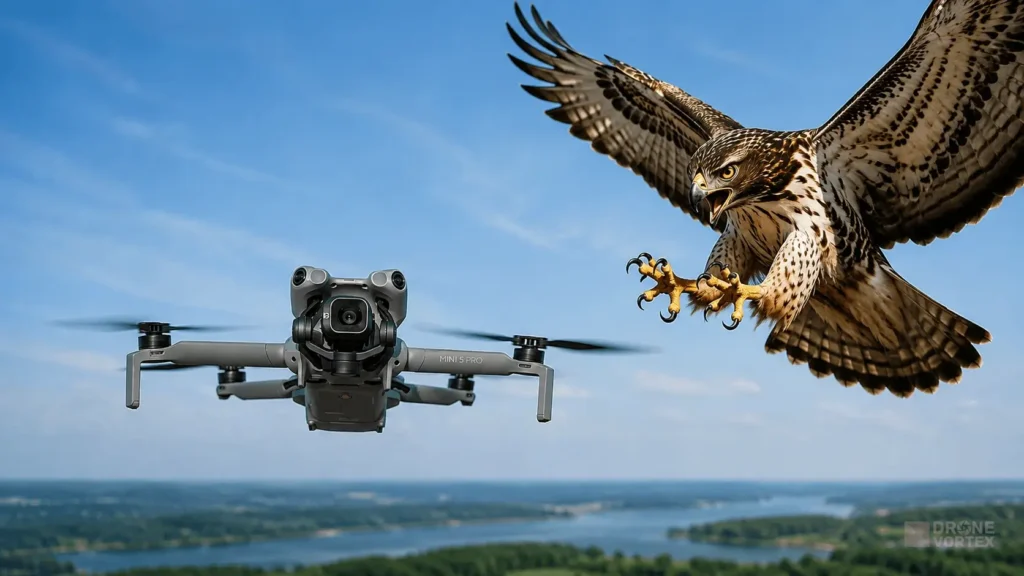
If you fly long enough, it will happen: a shape drops out of the sky, closes fast, and your drone is suddenly fighting for its life a hundred feet in the air. Bird attacks are one of the most common, and most avoidable, ways drones get damaged or lost entirely.
This guide covers everything you need to know to stop birds attacking drones, from understanding why it happens in the first place, to the exact maneuver that breaks off an active attack, to the deterrents that are actually worth buying versus the ones that are just marketing.
Unlike most guides on this topic, we’re not just listing generic tips. We’re breaking this down by bird species, by season, by real pilot outcomes, and by what to do in the ten seconds you actually have once a bird commits to an attack.
Table of Contents
Why Birds Attack Drones in the Sky
Birds don’t attack drones out of malice. They attack because a drone triggers one of three deeply wired instincts:
Territorial defense. Most bird attacks come from a bird protecting airspace it considers its own: a nesting site, a hunting perch, or a patch of sky it patrols daily. Your drone isn’t being punished; it’s being evicted.
Predator or rival response. Raptors in particular treat an unfamiliar flying object as either competition for prey or a direct threat to their young. A drone that hovers, circles, or descends slowly over a nest reads as exactly the kind of behaviour a predator would show before striking.
Curiosity that escalates. Smaller birds sometimes approach out of simple curiosity, mobbing the drone the way songbirds mob a hawk. This rarely causes damage on its own, but it can startle a pilot into an overcorrection that causes a crash anyway.
Understanding which of these three is driving the behaviour in front of you changes how you should respond, which is why the species breakdown below matters more than most generic guides admit.

Which Birds Actually Attack Drones (And How Each One Behaves)
Not all birds are equal threats. Knowing the profile of what’s in the air above you is the fastest way to predict and prevent an incident.
- Raptors (hawks, falcons, buzzards, kestrels): The most dangerous category. They attack with speed and talons, usually from above, and are most aggressive when defending a nest between spring and mid-summer. A peregrine or red-tailed hawk can close distance on a drone faster than almost any evasive maneuver can outrun horizontally.
- Gulls: Extremely persistent, especially on coastal and urban rooftops. Gulls rarely cause structural damage but will mob a drone in numbers, screaming and diving repeatedly, and will often follow it all the way down to a landing.
- Corvids (crows, ravens, magpies, rooks): Smart, territorial, and capable of coordinated harassment. Magpies in particular are notorious for sustained, aggressive dive attacks, and corvids have been known to escort a drone well outside their own territory before giving up.
- Eagles: Less common but capable of ending a flight in a single hit. Golden eagles and similar large raptors have been documented physically grabbing and dropping drones.
- Hummingbirds and small songbirds: Surprisingly territorial in breeding season, especially around feeders or flowering plants, though the risk to the drone itself is minimal.
Recognizing the species mid-flight tells you how much time you have and how hard the bird is likely to commit; a gull mobbing you is a very different situation from a peregrine stooping on you from above.

Prevention Beats Reaction: Stop Birds Attacking Drones Before You Take Off
The single most effective way to stop birds attacking drones is never letting the encounter start. A few minutes of pre-flight observation consistently prevents more incidents than any in-flight maneuver ever will.
1. Scout the site before you launch
Stand at your takeoff point for five to ten minutes and just watch the sky. Raptors patrolling a site will show themselves. Gulls nesting on an adjacent roof will be audible before they’re visible. If you see repeated activity over one area, treat that airspace as occupied territory and plan your flight path around it.
2. Know the nesting calendar
Bird aggression is heavily seasonal. Spring through early summer is peak nesting season across most of the Northern Hemisphere, and this is when territorial attacks spike dramatically. A hawk that ignores drones in November can become genuinely dangerous in May when it’s guarding chicks. If you’re flying a site repeatedly, log which months produced encounters, since the pattern will repeat year over year.
3. Fly at the right time of day
Most raptors are least active in the middle of the day and most active in the two hours after sunrise and before sunset, when thermals are weaker and hunting activity peaks. A midday flight window, even with slightly flatter light, is measurably safer than a dawn or dusk flight in bird-heavy areas.
4. Respect altitude bands
Most territorial patrol and hunting behaviour happens in a specific low-to-mid altitude band, roughly 30 to 260 feet depending on species and terrain. Climbing through that band steadily rather than lingering inside it reduces the window a bird has to notice, evaluate, and commit to an attack.
5. Keep your distance and your flight path predictable
A drone flown in a straight line at constant altitude reads as far less threatening than one that’s hovering, circling, or slowly descending over a nest or perch. Where possible, keep at least 50 to 100 feet of buffer from any bird you can see, and never fly directly at one, since a direct approach reads as predatory and is the fastest way to provoke a defensive strike.
6. Choose a smaller, quieter aircraft where the mission allows it
Bulk and prop noise both increase how threatening a drone appears to a bird. On jobs where you have equipment options, a smaller, quieter airframe genuinely draws fewer aggressive responses than a large, loud one flying the same route.

Real-Time Tactics: What to Do the Moment a Bird Engages
Prevention fails sometimes. When a bird actually commits to an attack, you have seconds, not minutes, and the instinctive response, accelerating away horizontally, is usually the wrong one.
Stop forward motion and climb; don’t run. A drone retreating in a straight horizontal line looks exactly like fleeing prey, and a committed raptor will chase it for a surprising distance. Birds struggle to match a rapid vertical climb; going straight up is disorienting for them and is the single most reliable way to break contact. A clean climb of 100–300 feet is usually enough to end the engagement entirely.
Never descend toward the bird or the ground while it’s engaged. Losing altitude in front of an attacking bird invites a dive from above, and you won’t out-maneuver a stooping raptor on the way down.
Move laterally away from the territory once you’ve broken contact. Climbing alone sometimes isn’t enough if you’re still inside the bird’s territory. Once you have altitude, translate away from the area before descending again, since most birds lose interest quickly once you’re outside the zone they’re defending.
If the bird keeps pursuing after a climb, land immediately at the nearest safe spot. Don’t try to push through a sustained pursuit to finish a shot. A drone on the ground is a drone you still own.
Use sport or high-performance flight modes if your aircraft has them. The extra vertical climb rate and control authority genuinely matter in the first two seconds of an engagement.
If you’re flying with an observer, brief them specifically for this. A dedicated spotter watching the sky, not the controller screen, will see an incoming bird well before the pilot does. Agree a short callout in advance (“bird, twelve o’clock, closing”) and a standing rule: on a confirmed call, stop and climb immediately, no discussion mid-attack.
Do Physical Deterrents Actually Work?
This is where pilot forums are full of contradictory advice, so here’s an honest breakdown of what’s commonly tried and what the actual track record looks like.
| Deterrent | Reported effectiveness | Trade-off |
| Reflective/holographic tape | Mixed: some pilots swear by it, others see no change | Minimal weight, cheap, worth trying |
| Predator eye stickers | Mostly cosmetic, occasional anecdotal success | Harmless but unreliable |
| Strobe lights | Some pilots report noticeably fewer approaches | Adds negligible weight; useful for visibility too |
| Propeller guards | Doesn’t deter attacks, but reduces bird injury and prop damage on contact | Adds drag and weight |
| Zip ties/spikes on the frame | Anecdotal deterrent for close-range attackers like magpies | Cosmetic changes to airframe, may affect balance |
| Yellow-and-black warning patterns | Some pilots report a drop in interest after applying | Purely visual, essentially free to try |
| Loud noise devices | Largely ineffective and can attract more attention | Not generally recommended |
The honest takeaway: no deterrent reliably stops a genuinely aggressive, territorial bird. The pilots who see the best results combine a light visual deterrent (tape, stickers, or a strobe) with the behavioural tactics above, site scouting, timing, and altitude discipline, rather than relying on a sticker to do the work alone. If you’re modifying your drone with anything, weigh it before and after; small add-ons can be enough to push a drone over a regulatory weight threshold depending on where you fly.
What Not to Do During a Bird Encounter
- Don’t try to fend the bird off with the drone itself. Deliberately striking, chasing, or harassing a wild bird can be illegal under wildlife protection law in many countries, and it’s also far more likely to damage your aircraft than the bird.
- Don’t panic-yank the controls. Sudden erratic inputs are more likely to cause a crash than the bird itself is.
- Don’t keep filming through a sustained attack to save a shot. A damaged or downed drone costs far more than a missed clip.
- Don’t descend to try to “duck under” the bird. This is consistently the maneuver that ends in the worst outcomes.
After the Encounter: Inspection and Reporting
Once you’ve landed safely, don’t just pack up and move on.
- Inspect the airframe and propellers for hairline cracks or bent motor mounts before your next flight, since even a glancing contact can weaken a prop enough to fail later.
- Check gimbal and camera alignment if the bird made contact, since a jolt can knock calibration off without any visible damage.
- Log the location, species, and time of day. This turns a one-off scare into a data point you can use to avoid the same spot during the same season next year.
- Report the incident if required. In several jurisdictions, an encounter that led to loss of control, damage, or any risk to people or property counts as a reportable occurrence to the local aviation authority, and commercial insurance policies frequently require prompt reporting as a condition of cover.
Quick Reference Checklist
- Scout the launch site for five minutes before flying
- Check whether it’s nesting season for local raptors, gulls, or corvids
- Fly midday where possible, avoiding dawn and dusk in bird-heavy areas
- Climb through low-altitude bird bands quickly rather than lingering
- Keep at least 50–100 feet of buffer from any visible bird
- Use an observer dedicated to watching the sky, not the screen
- If attacked: stop, climb, don’t run horizontally, don’t descend
- Move away from the territory before landing or resuming the flight
- Land immediately if a pursuit continues after a climb
- Inspect the aircraft and log the encounter afterward
FAQ
What’s the single best way to stop birds attacking drones mid-flight?
Climb vertically and stop forward motion. Birds are far less able to match a fast vertical climb than they are to chase a horizontal retreat, and gaining 100–300 feet of altitude ends most engagements outright.
Do reflective stickers or tape really stop birds attacking drones?
They help some pilots in some situations, but results are inconsistent. Treat visual deterrents as a small edge, not a guarantee. The behavioural tactics (timing, altitude, distance) do far more of the actual work to stop birds attacking drones.
Which birds are most likely to attack a drone?
Territorial raptors during nesting season, gulls on coastal or rooftop territory, and corvids like crows and magpies are the most common and most persistent attackers.
Is it illegal to defend a drone against a bird by striking it?
In many countries, wild birds are legally protected, and deliberately harming one, even in defence of your drone, can carry legal consequences. The recommended response is always to disengage, not confront.
Should I fly a smaller drone in bird-heavy areas?
Where the job allows it, yes. Smaller, quieter aircraft draw less aggressive attention than larger, louder ones flying the same route, which is one more practical way to stop birds attacking drones before an encounter even starts.
Final Thoughts
Most bird attacks are predictable if you know what to look for, and the drones that get damaged are usually the ones flown without a pre-flight look at the sky or a plan for what happens if a bird actually commits. Combine a proper site scout, seasonal awareness, and altitude discipline on the way up with a fast, disciplined climb-and-retreat if a bird does engage, and you’ll turn what used to be a coin-flip into a manageable, repeatable process. That combination, not any single gadget, is genuinely how experienced pilots stop birds attacking drones for good.
Read More: 28 Must-Know Tips & Settings for DJI Neo 2 (Part 1)