
If you’re setting up an FPV build in 2026, this is one of the first real decisions you’ll face. Do you go with DJI’s own dedicated radio, the DJI Remote Controller 3 (often shortened to RC3), or do you build around ELRS, the open-source protocol that dominates the rest of the FPV world? Both are genuinely excellent options, and the DJI FPV RC 3 vs ELRS Controller debate isn’t really about which radio is “better” in the abstract. It’s about which one actually fits the way you fly.
This guide breaks down how each system works, what you’re trading off in range, latency, and setup complexity, and walks through exactly when each option wins, so you’re not left guessing after reading five different forum threads that all disagree with each other.
Quick summary
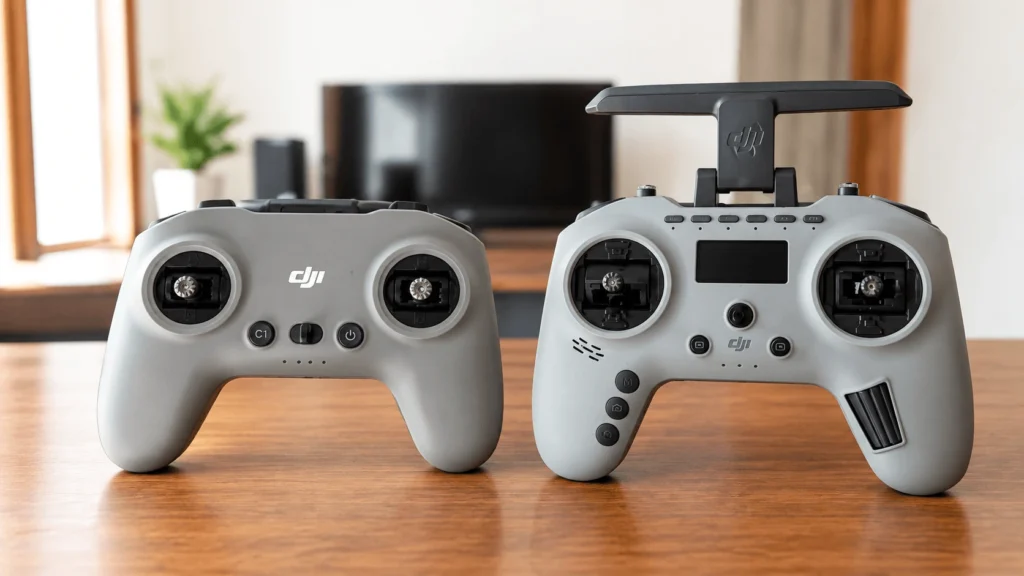
The DJI Remote Controller 3 is DJI’s dedicated FPV radio, built specifically for O4 and O3 digital systems. It binds directly to a compatible DJI air unit with no soldering and no separate receiver, and for most pilots flying DJI’s own digital ecosystem, that simplicity makes it the easier choice.
ELRS (ExpressLRS) is an open-source protocol that works across a huge range of radios and receivers from brands like RadioMaster, and it wins on flexibility, letting you fly analog, HDZero, Walksnail, or DJI-compatible builds all from a single transmitter, along with generally lower latency at its highest packet rates.
If you’re fully committed to DJI’s O3/O4 digital ecosystem and want the simplest setup possible, the DJI Remote Controller 3 is the right call. If you fly multiple video systems, race competitively, or just want more hardware freedom, ELRS is the stronger long-term choice.
What Is the DJI Remote Controller 3?
The DJI Remote Controller 3 (RC3) is DJI’s purpose-built radio for FPV flying with DJI’s own digital video systems. Instead of using an open protocol like ELRS or Crossfire, it communicates directly with a DJI O4 or O3 Air Unit using DJI’s proprietary 2.4GHz link, the same link that also carries your video feed. Binding it to a drone works essentially like pairing a Bluetooth device: no soldering a receiver to your flight controller, no wiring a UART port, no separate firmware to flash.
That convenience comes with a real limitation. The RC3 only works with DJI’s own digital hardware, specifically drones running an O3 or O4 Air Unit, paired with DJI Goggles 3 or Goggles N3. It has no ability to control analog, HDZero, or Walksnail systems, and it isn’t backward compatible with older DJI FPV Goggles V2 or Goggles 2.
What Is ELRS?
ExpressLRS, universally shortened to ELRS, is an open-source radio control protocol that has become the de facto standard across most of the FPV hobby outside DJI’s ecosystem. Rather than being tied to one manufacturer’s hardware, ELRS is implemented across dozens of transmitter and receiver products from brands like RadioMaster, BetaFPV, and TBS, giving pilots enormous flexibility in choosing gimbal feel, form factor, and price point.
ELRS is built for two things above all else: range and low latency. On 2.4GHz, it commonly runs at a 500Hz packet rate, with newer hardware and firmware supporting an even faster F-1000Hz mode for pilots who want the lowest possible control latency, useful in racing and freestyle where split-second stick response matters. The tradeoff is setup complexity: getting an ELRS receiver working means soldering it to your flight controller’s UART pads, flashing matching firmware on both the radio and receiver, and binding them manually.
DJI Remote Controller 3 vs ELRS Controller: Full Specification Comparison
| Specification | DJI Remote Controller 3 | Typical ELRS Setup (e.g. RadioMaster + ELRS module) |
| Weight | Approx. 240g | Varies by radio, commonly 300-700g for full-size transmitters |
| Battery | 2600mAh internal, ~10 hours | Varies by radio, often 18650 cells, several hours to over a day depending on model |
| Charging | 5V/2A USB, ~2-hour full charge | Varies by radio, USB-C common on modern models |
| Dimensions | 165 x 119 x 62mm | Varies significantly by transmitter model |
| Frequency | 2.400-2.4835 GHz | 2.4GHz (900MHz variants also exist) |
| Max EIRP (FCC/US) | 26 dBm | Up to 30 dBm on high-power ELRS modules |
| Max EIRP (CE/UK) | Under 20 dBm | Typically 20 dBm under CE regulations |
| Max packet rate | Tied to DJI’s proprietary link | Up to 500Hz standard, up to F-1000Hz on supported hardware/firmware |
| Typical control range | ~10km under ideal conditions | Comparable at standard settings; 100km+ demonstrated on dedicated long-range configurations |
| Setup required | None; wireless bind, no soldering | Receiver soldering, firmware flashing, manual bind |
| Compatible video systems | DJI O3/O4 digital only | Any protocol: analog, HDZero, Walksnail, and DJI-compatible builds |
| Approx. price (radio only) | Around $269 (varies by region) | Varies widely, roughly $60-$500+ depending on radio and module |
Setup and Ease of Use
This is where the gap between these two systems is the widest. Setting up the DJI Remote Controller 3 is close to plug-and-play: power on your O3 or O4 drone, put the RC3 into bind mode, and the two devices connect in a matter of seconds, using the same built-in receiver that’s already inside the air unit. There’s genuinely no extra hardware to buy or solder for most DJI digital builds.
An ELRS setup asks more of you. You’ll need to solder a receiver to your flight controller’s UART pads, make sure the receiver and transmitter are running matching ELRS firmware versions, flash any updates through the ExpressLRS Configurator, and then bind the two together, often through a Lua script on the radio. Once it’s done it’s reliable and rarely needs touching again, but the up-front process is a genuine barrier for beginners who aren’t comfortable with a soldering iron.
Range, Control Link, and Latency
Both systems perform well within realistic flying distances, but they get there differently. The DJI Remote Controller 3’s control range is tied directly to the O3/O4 video link itself, since control and video ride the same proprietary connection. In practice, that means real-world range of around 10km (roughly 8 miles) under ideal FCC conditions, and pilots generally find that if the video feed is still working, control is too.
ELRS, running independently of your video system, has a dramatically higher ceiling. For typical freestyle and racing setups at standard power levels, range is broadly comparable to or a bit beyond the DJI link. But ELRS was specifically engineered for long-range performance, and dedicated long-range builds using lower packet rates, higher transmit power, and directional antennas have demonstrated control ranges of 100km or more, including at least one documented flight that maintained a working link and telemetry at 100km using just 100mW of power.
That’s a specialized use case most pilots will never need, but it illustrates the technical ceiling ELRS is capable of that a closed, proprietary system like DJI’s doesn’t offer.
On latency, ELRS has a technical edge at its highest settings. Running at a 500Hz standard packet rate, and up to F-1000Hz on supported hardware and firmware, ELRS is capable of extremely fast, precise stick response, which matters most in competitive racing and technical freestyle flying. The DJI Remote Controller 3’s link is fast and highly reliable for the vast majority of flying styles, but pilots chasing the absolute lowest latency for competition tend to still reach for ELRS.
Compatibility: The Real Deciding Factor
For a lot of pilots, the DJI Remote Controller 3 vs ELRS Controller decision really comes down to one question: what are you actually flying? The DJI Remote Controller 3 works exclusively with DJI’s own O3 and O4 Air Unit-equipped drones, along with the Avata 2 and Neo, and it requires DJI Goggles 3 or Goggles N3, it won’t pair with older Goggles V2 or Goggles 2 at all. If your entire fleet is built around DJI’s digital ecosystem, this narrow focus isn’t a downside, it’s exactly what makes the RC3 so simple to use.
ELRS takes the opposite approach. Because it’s an open protocol implemented by many manufacturers, a single ELRS radio can control analog quads, HDZero builds, Walksnail setups, and DJI-compatible ELRS receivers, all from one transmitter. If your hangar includes a mix of video systems, or you expect it to grow that way, ELRS avoids being locked into a single ecosystem.
Cost Considerations
The DJI Remote Controller 3 carries a single, known price for the radio itself, generally around $269 in the US depending on region and retailer, and because the receiver is already built into every O3/O4 Air Unit, there’s no separate receiver cost per drone.
ELRS pricing is more variable: the radios themselves range from budget options costing well under $100 to premium transmitters with high-end gimbals costing several hundred dollars, and each additional quad needs its own ELRS receiver, typically $15-$30, which adds up if you’re running a larger fleet.
Betaflight Setup Basics
Both systems ultimately need to be configured correctly in Betaflight to fly properly, and the process differs meaningfully between them.
For a DJI O3/O4 build: bind the RC3 to your air unit, then in Betaflight Configurator set the air unit’s relevant UART to “Serial RX” and choose “SBUS” as the receiver protocol. Confirm your stick inputs map correctly to the right channels, save, and range-test in an open area before your first real flight.
For an ELRS build: after soldering your receiver to your flight controller’s RX/TX pads and confirming both the receiver and transmitter run matching firmware, set the receiver’s UART to “Serial RX” in Betaflight and choose “CRSF” as the protocol. Bind the receiver to your radio, verify channel mapping, save, and range-test before flying.
Who Should Buy the DJI Remote Controller 3
- Pilots fully committed to DJI’s O3/O4 digital ecosystem who want the simplest possible setup
- Anyone who wants to avoid soldering receivers entirely
- Travelers who want a single, compact radio that just works out of the box
- Casual and freestyle flyers who don’t need competition-grade latency
Who Should Buy an ELRS Controller
- Pilots flying a mix of analog, HDZero, Walksnail, or multiple DJI-compatible quads
- Racers and technical freestyle flyers who want the lowest possible latency
- Anyone who wants freedom to choose radio hardware, gimbal feel, and form factor
- Pilots comfortable with soldering and firmware setup in exchange for long-term flexibility
Frequently Asked Questions
What’s the maximum range of ELRS compared to the DJI Remote Controller 3?
The DJI Remote Controller 3 is limited to the O3/O4 video link’s real-world range of around 10km. ELRS has a much higher technical ceiling: dedicated long-range configurations using low packet rates and directional antennas have demonstrated control ranges of 100km or more, though that’s a specialized setup most everyday pilots won’t need.
Does the DJI Remote Controller 3 work with non-DJI drones?
No. It only communicates with drones running a DJI O3 or O4 Air Unit. It cannot bind to ELRS, Crossfire, or any other receiver protocol.
Is ELRS better than the DJI Remote Controller 3 for racing?
For competitive racing, many pilots prefer ELRS because of its very high packet rates, up to F-1000Hz on supported hardware, and the flexibility to pair it with lightweight, race-tuned quads across different video systems.
Can the DJI Remote Controller 3 work with older DJI FPV Goggles?
No. The RC3 is compatible with DJI Goggles 3 and Goggles N3 only. It does not work with the older DJI FPV Goggles V2 or Goggles 2.
Do I need to solder anything to use the DJI Remote Controller 3?
No. Since the receiver is already built into every O3 and O4 Air Unit, the RC3 binds wirelessly with no soldering or extra receiver hardware required.
Which is cheaper overall, DJI Remote Controller 3 or ELRS?
It depends on fleet size. The DJI Remote Controller 3 has one upfront cost and no per-drone receiver expense within DJI’s ecosystem. ELRS radios vary widely in price, and each additional quad typically needs its own $15-$30 receiver, which can make ELRS costlier for larger fleets but cheaper for a single budget-focused build.
Final Verdict
There’s no universal winner in the DJI Remote Controller 3 vs ELRS Controller debate, and that’s really the whole point. The DJI Remote Controller 3 is the better choice if your entire setup lives inside DJI’s O3/O4 digital ecosystem and you want a radio that binds in seconds with zero soldering.
ELRS is the better choice if you fly across multiple video protocols, want the fastest possible packet rates for racing, or simply want the freedom to pick your own hardware rather than being tied to one manufacturer’s walled garden. Match the radio to how you actually fly, not to which one shows up first in comparison videos, and you’ll end up happy with either.
Read More: Insta360 Luna Ultra Review