
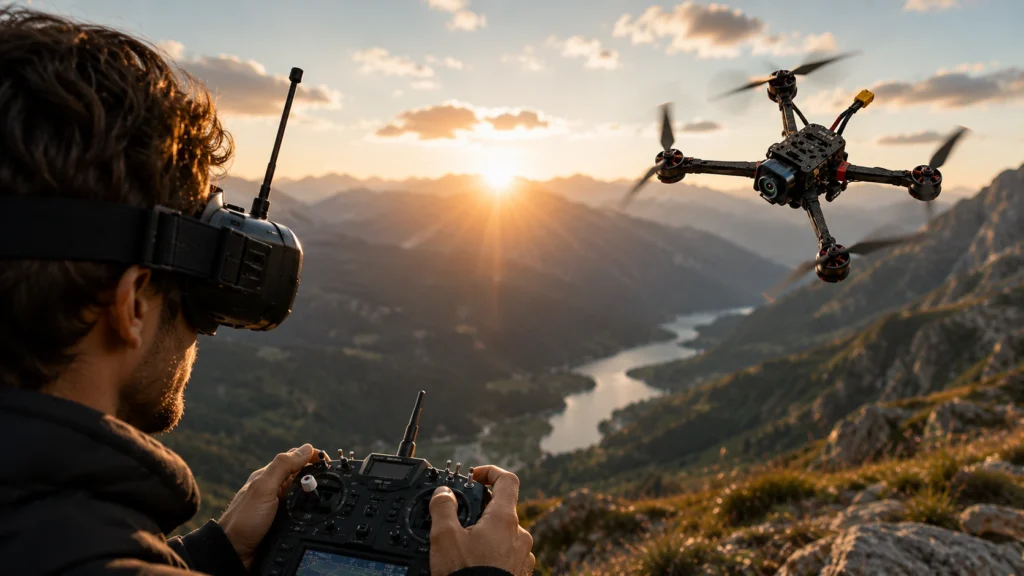
An FPV drone (First Person View drone) is an unmanned aircraft that streams live video from an onboard camera directly to the pilot’s goggles or monitor, letting the pilot fly as if they were sitting inside the aircraft’s cockpit. Unlike GPS-stabilized camera drones, most FPV drones fly in manual “acro” mode with no autopilot, which is what allows the flips, dives, and high-speed proximity flying the hobby is known for.
I’ve spent enough time crashing (and eventually not crashing) FPV drones to know that most explanations of “what is an FPV drone” online are written by people who have never actually strapped on a pair of goggles. This guide is written from the other side of that experience. We’ll cover what an FPV drone actually is, how the whole system works under the hood, how it’s different from a normal camera drone, the different types of FPV drones you’ll come across, what it costs to get into the hobby, and the legal rules you need to know before your first flight.
Table of Contents
What Is an FPV Drone, Exactly?
An FPV drone is a small unmanned aircraft equipped with a camera that transmits real-time video to the pilot, who controls the drone using a radio transmitter while watching that live feed through goggles or a screen. There is no autopilot holding the drone steady, no GPS locking it in place, and no separate person standing there flying it like a remote-control toy car. The pilot is, functionally, sitting in the cockpit.
This is different from how most people picture drone flying. When someone flies a DJI Mini or a Mavic, they’re usually standing on the ground, glancing between the drone in the sky and a phone screen showing the camera view. An FPV drone pilot never looks at the actual aircraft. Their eyes are inside the goggles the entire flight, watching a first-person feed streamed directly from the drone’s nose camera.
That immersive first-person perspective is the entire point of FPV flying. It’s why FPV footage feels so different from a normal drone shot. It’s also why FPV drones are used for racing, freestyle acrobatics, cinematic filmmaking, and increasingly for industrial inspection and search and rescue work where getting a close-up view of tight spaces matters more than a smooth wide shot.
How Does an FPV Drone Actually Work?
Underneath the goggles and the carbon fiber frame, an FPV drone is really three separate systems working together at the same time. Understanding these three data flows is the fastest way to understand why FPV flying feels so fundamentally different from flying a regular drone.
| System | What it carries | Key hardware | Why it matters |
| Video link | Live first-person feed from drone to pilot | FPV camera, video transmitter (VTX), goggles | Latency here directly affects safety and precision |
| Control link | Stick inputs from pilot to drone | Radio transmitter, receiver (Rx), flight controller | Determines throttle, pitch, roll, and yaw |
| Telemetry link | Battery voltage, signal strength, GPS data | On-screen display (OSD) | Lets the pilot monitor flight status without looking away |
The video link
A small FPV camera mounted on the nose of the drone captures a wide angle view of whatever is in front of it. This camera is optimized for low light performance and fast motion rather than picture quality, because its job is to help the pilot see clearly during hard turns and dives, not to produce cinema footage. That video is sent to a video transmitter, usually called a VTX, which broadcasts the signal on either the 5.8GHz analog band or a digital protocol depending on the system.
Latency matters enormously here. Even a delay of a few extra milliseconds between what the camera sees and what the goggles display can be the difference between threading a narrow gap and crashing into it. Analog FPV systems typically deliver latency under 10 milliseconds, which is why many racing pilots still prefer them despite the lower image quality. Modern digital systems from DJI and Walksnail bring that latency up to somewhere between 20 and 40 milliseconds in exchange for dramatically sharper, clearer video.
The control link
While the video link sends information from the drone to the pilot, the control link works the other way. The pilot’s radio transmitter sends stick inputs, throttle, pitch, roll, and yaw, to a receiver mounted on the drone. This link uses protocols like ExpressLRS or Crossfire and is completely separate hardware from the video system, since one channel carries flight commands and the other carries the live feed.
Most FPV drones fly in what pilots call acro mode, short for acrobatic mode. Unlike a GPS-stabilized drone that hovers in place the moment you let go of the sticks, an FPV drone in acro mode has no self-leveling and no autopilot. Release the sticks mid-flight and the drone simply keeps doing whatever it was doing. This is exactly what allows flips, rolls, and aggressive freestyle maneuvers, but it also means the pilot is actively flying the aircraft every single second it’s in the air.
The telemetry link
The third data flow running in the background is telemetry. Information like battery voltage, signal strength, and sometimes GPS position gets transmitted back to the pilot and displayed as an on-screen display, or OSD, overlaid directly on the video feed. This lets a pilot glance at critical flight data without ever looking away from the first-person view, which matters a lot when you’re flying at 80 miles an hour six feet off the ground.
Put all three together and you get the full picture: the pilot sends commands through the control link, the flight controller onboard the drone reads those commands along with data from its gyroscope and accelerometer, and it adjusts the speed of each motor through the electronic speed controllers to produce the requested movement. Meanwhile the video link is streaming the drone’s view back to the goggles in near real time, and the telemetry link is quietly keeping the pilot informed the whole way through.
FPV Drone vs Regular Drone: What’s Actually Different?
People often ask what separates an FPV drone from a standard camera drone like a DJI Mavic or Air series, and the honest answer is that they’re built for almost opposite goals. Here’s the comparison side by side before we dig into why.
| Feature | FPV Drone | Regular Drone |
| Flying perspective | First-person, through goggles | Third-person, from the ground |
| Flight mode | Manual (acro), no autopilot | GPS-stabilized, auto-hover |
| Learning curve | Steep, requires simulator practice | Gentle, flies stable out of the box |
| Typical speed | 60 to 120+ mph | 30 to 45 mph |
| Camera setup | Separate cameras for flying and recording | Single gimbal camera for both |
| Safety features | Usually none, pilot skill only | Obstacle avoidance, return-to-home, geofencing |
| Battery life | 3 to 6 minutes (aggressive flying) | 25 to 40 minutes |
| Repairability | Easy, swap parts yourself | Often requires manufacturer repair |
| Best for | Racing, freestyle, proximity flying | Aerial photography, mapping, casual flying |
A regular consumer drone is designed around stability and ease of use. GPS locks the aircraft in place, obstacle avoidance sensors prevent collisions, and a gimbal isolates the camera from the drone’s movement so footage stays smooth even in wind. Let go of the controls and the drone simply hovers, waiting for your next command. You can get usable, cinematic footage within minutes of taking it out of the box, which is exactly why these drones dominate the aerial photography and real estate market.
An FPV drone throws almost all of that away in favor of raw manual control, speed, and agility. There’s typically no obstacle avoidance, no automatic return to home, and often no GPS at all. The pilot has full and constant responsibility for keeping the aircraft in the air, which is exactly why FPV drones can pull off flips, dives, and proximity flying through tight gaps that would be impossible for a GPS-stabilized drone. Racing and freestyle FPV drones can hit speeds well over 80 to 100 miles per hour, compared to the 30 to 45 mile per hour range typical of a consumer camera drone.
The flying experience is different too. A regular drone pilot is essentially directing a smart camera from the ground, watching a small screen and nudging the aircraft into position. An FPV pilot is inside the cockpit through the goggles, reacting instantly to what’s directly ahead of the drone. That’s a steeper learning curve, and it’s the reason most FPV pilots spend 10 to 40 hours practicing on a flight simulator before they ever fly a real aircraft.
Battery life reflects the different priorities as well. A consumer drone optimized for stable, efficient flight can often stay airborne for 25 to 40 minutes. An FPV drone flown aggressively in acro mode typically only lasts three to six minutes per battery, since so much power goes toward raw thrust rather than efficiency.
Types of FPV Drones
FPV drones aren’t a single category of aircraft. They range from palm-sized indoor toys to massive rigs capable of carrying cinema cameras, and each type is built around a different flying style.
Tiny whoops
Tiny whoops are small, lightweight FPV drones, usually under 75mm motor to motor, with enclosed propeller ducts that protect the props from bumps into walls and furniture. They’re the standard recommendation for absolute beginners because they’re safe to fly indoors and forgiving of crashes.
Toothpick drones
Toothpick drones get their name from their thin, minimalist frames. They’re extremely lightweight and agile, making them a good step up from a tiny whoop for pilots who want to practice outdoor acro flying without the cost or risk of a full-sized freestyle quad.
Cinewhoops
Cinewhoops sit between tiny whoops and full freestyle drones, using ducted propellers similar to a whoop but at a larger size, typically around 3 inches. They’re built to carry small action cameras like a GoPro and are popular for real estate walk-through videos and interior filmmaking, since the ducts make them safe to fly close to people and furniture.
Racing drones
Racing drones are purpose-built for speed. Most use 5-inch propellers on lightweight carbon fiber frames and fly exclusively in acro mode, with every component chosen to maximize the power-to-weight ratio rather than camera quality or flight time. Organized drone racing leagues use standardized 5-inch quads with specific motor and battery restrictions.
Freestyle drones
share similar hardware with racing drones but are built more durably to survive the crashes that come with aggressive flips, dives, and proximity flying. Freestyle pilots often mount an action camera to capture their runs, and the resulting footage is what most people picture when they imagine dramatic FPV content.
Long-range drones
Long-range drones use larger frames, often 7-inch propellers or bigger, efficient motors, and sometimes GPS assistance to cover several kilometers on a single battery. These are built for scenic exploration and aerial surveying rather than tight acrobatics.
Cinelifters
Cinelifters are the heavyweight class of FPV, using six to eight motors to carry professional cinema cameras like a RED Komodo or Blackmagic Pocket. They combine FPV’s precise maneuvering with cinema-grade image quality and are used in film and commercial production.
FPV drones are also grouped by size, which directly affects handling and where they can be flown:
| Size class | Propeller size | Best for |
| Small | Under 4 inches | Indoor flying, tiny whoops, toothpicks |
| Medium | 4 to 6 inches | Racing and freestyle (5-inch is the industry standard) |
| Large | 7 inches and above | Long-range flying, professional cinematography |
Essential Components of an FPV Drone
Even if you buy a ready-to-fly FPV drone rather than building your own, it helps to understand what each part does.
- FPV camera: Captures the pilot’s view and is optimized for low light and fast motion rather than resolution, since its job is to help you fly, not to produce cinema-grade footage
- Video transmitter (VTX): Broadcasts that feed to the goggles over analog or digital signal
- FPV goggles: Block outside light and display the video feed directly in front of the pilot’s eyes, with many models including a built-in DVR to record the flight
- Radio transmitter and receiver: Handle the control link, sending stick inputs for throttle, pitch, roll, and yaw
- Flight controller: The drone’s brain, reading sensor data and pilot commands to calculate exactly how fast each motor should spin
- Motors and ESCs: Electronic speed controllers turn those calculations into actual thrust
- Frame: Usually carbon fiber, holds everything together while absorbing the impact of crashes
- Battery: A high-discharge LiPo battery supplies the burst of current needed for aggressive acrobatic flight
Analog vs Digital FPV: Which Should You Choose?
One of the first real decisions in FPV is choosing between analog and digital video systems, and it’s worth understanding because it locks you into an ecosystem, digital goggles generally only work with a matching brand’s video transmitter, so switching ecosystems later means replacing both.
| Feature | Analog | Digital |
| Image quality | Standard definition, visible static | 720p to 1080p, clear image |
| Latency | Under 10ms | 20 to 40ms |
| Range | 1 to 2 km typical | 4 to 10 km with clear line of sight |
| Cost (goggles) | $50 to $150 | $200 to $650 |
| Ecosystem | Universal, works across brands | Locked to manufacturer (DJI, Walksnail) |
Analog FPV was the original standard and remains popular for its simplicity, low cost, and extremely low latency, which is why many racing pilots still choose it despite the grainier image. Digital systems from DJI and Walksnail deliver dramatically clearer video and longer usable range in exchange for slightly higher latency and a higher price tag.
How Much Does an FPV Drone Cost?
FPV has options at almost every budget level, but the total investment depends on whether you’re buying a complete ready-to-fly system or building from individual parts.
| Tier | Cost range | What’s included |
| Beginner RTF kit | $200 to $500 | Drone, basic goggles, controller, battery, charger |
| Committed hobbyist (BNF) | $500 to $1,500 | Quality radio ($150-350), goggles ($200-650), BNF airframe ($200-600), batteries and spares |
| Professional / cinelifter | $2,000+ | HD digital goggles, premium transmitters, multiple specialized airframes |
A beginner all-in-one kit is tuned for safety and ease of use but usually comes with lower quality gear that serious hobbyists outgrow quickly. A committed hobbyist setup, where you buy a quality radio and goggles separately and pair them with a bind-and-fly drone, is the sweet spot for most people who stick with the hobby past their first few months. Professional and commercial setups add HD digital goggles, premium transmitters, and multiple specialized airframes for different jobs.
There are also ongoing costs to budget for regardless of tier. FPV flying involves frequent crashes, especially while learning, so expect to regularly replace propellers, motors, frames, and batteries. Batteries alone typically cost $20 to $40 each and need periodic replacement every year or two depending on use.
Is FPV Drone Flying Legal?
Yes, FPV drone flying is legal in most countries, including the United States, but it comes with a specific set of rules that every pilot needs to understand before their first flight.
The biggest legal consideration for FPV pilots is the visual line of sight requirement, often written as VLOS. Most aviation regulations require the remote pilot to maintain direct visual contact with their aircraft at all times. Since FPV goggles physically block the pilot’s view of the real world, this creates an obvious problem, and the solution is a visual observer, sometimes called a spotter, a second person standing next to the pilot who keeps the drone in direct sight and communicates hazards, obstacles, and aircraft position while the pilot flies through the goggles.
| Flight type | Certification needed | Registration | Visual observer |
| Recreational | Free TRUST test | Required over 250g | Required for FPV |
| Commercial | Part 107 Remote Pilot Certificate | Required over 250g | Required for FPV |
For recreational flying in the United States, pilots need to pass the TRUST test (The Recreational UAS Safety Test), a free online exam that cannot be failed since it’s designed as an educational tool. Drones weighing more than 250 grams must also be registered with the FAA. For any commercial use, including paid videography, real estate tours, or inspection work, a Part 107 Remote Pilot Certificate is required, involving a formal knowledge test at an approved testing center and recurrent training every 24 months.
Beyond licensing, universal rules apply to nearly everyone:
- Stay below 400 feet above ground level
- Avoid flying over people or moving vehicles without proper authorization
- Get LAANC authorization for controlled airspace near airports
- Always yield right of way to manned aircraft
True long-range FPV flying that exceeds visual line of sight, even with a spotter, generally requires a specialized BVLOS (beyond visual line of sight) waiver that isn’t typically granted to hobbyist pilots.
Getting Started With FPV Flying
If there’s one piece of advice every experienced FPV pilot agrees on, it’s this: buy a simulator before you buy a drone. Flying in acro mode is a genuinely new skill, closer to learning an instrument than driving a car, and your brain needs time to build the muscle memory to instinctively correct the aircraft’s orientation. Popular simulators like Liftoff, Velocidrone, and Orqa FPV.SkyDive replicate real flight physics closely enough that skills transfer directly to a real drone, and crashing in a simulator costs nothing.
A sensible progression looks like this:
- Simulator phase (2 to 4 weeks): Practice with a real radio transmitter and a flight simulator until you can fly circuits, land consistently, and recover from orientation mistakes
- Tiny whoop phase (1 to 2 months): Fly a small indoor drone to learn real-world variables like spatial awareness and throttle control without high crash costs
- Outdoor phase: Graduate to a 3-inch or 5-inch drone outdoors in open, obstacle-free space once you’re consistently landing and recovering
- Specialization: Focus on racing, freestyle, cinematic work, or long-range flying based on whatever pulled you into the hobby in the first place
It’s also worth deciding early whether you want a ready-to-fly kit or a bind-and-fly setup.
| Path | What it is | Best for |
| RTF (Ready-to-Fly) | Everything included in one box | Casual beginners testing the hobby |
| BNF (Bind-N-Fly) | You supply your own radio and goggles | Committed beginners who plan to upgrade |
| PNP (Plug-and-Play) | Requires soldering your own receiver | Experienced builders only |
RTF kits are the easiest starting point since everything is included, but the gear is usually lower quality and gets replaced quickly. BNF setups cost more upfront but let you choose a quality radio and goggles from the start, which stay with you across multiple drones as you crash and upgrade the airframe itself.
Frequently Asked Questions
What is the point of an FPV drone?
The main purpose of an FPV drone is to give the pilot a first-person flying experience, seeing exactly what the drone sees in real time rather than watching it from the ground. This makes flying feel more immersive and precise, and it enables the racing, freestyle, and cinematic flying that define the FPV hobby.
How hard is it to fly an FPV drone?
Significantly harder than flying a GPS-stabilized consumer drone. There’s no automatic stabilization or obstacle avoidance, so the pilot has full manual control at all times. Starting with a flight simulator before attempting a real flight is the standard, strongly recommended path.
Do FPV drones have GPS?
Not always. Basic FPV models designed for racing and freestyle typically skip GPS to save weight and reduce latency. Long-range FPV drones often do include GPS for position hold and return-to-home safety features.
What is the difference between an FPV drone and a regular drone?
The core difference is control method and flying experience. Regular drones fly with GPS stabilization and hover automatically, operated by watching the aircraft or a screen from the ground. FPV drones stream live video to goggles for an immersive first-person perspective and typically fly in manual acro mode without GPS assistance, enabling aggressive maneuvers that standard drones can’t perform.
Do you need a license to fly an FPV drone?
For recreational flying, you need to pass the free TRUST test and register your drone with the FAA if it weighs over 250 grams. For commercial use of any kind, a Part 107 Remote Pilot Certificate is required.
Final Thoughts
An FPV drone puts the pilot inside the cockpit through a live video feed, turning drone flying from something you watch into something you experience. That immersive first-person perspective is what enables the tight proximity flying, high-speed racing, and expressive freestyle maneuvers that regular camera drones simply can’t replicate. The learning curve is real, the crashes are inevitable at first, and the gear ecosystem takes some research to navigate, but for anyone who’s watched FPV footage and felt that pull to try it themselves, there’s genuinely never been a more accessible time to get started.