
DJI has been leading the consumer drone market for years, but until recently, it had one gap in its lineup: a true 360-degree drone. That gap is now firmly closed with the Avata 360, the brand’s first-ever spherical-capture drone, and it arrives with serious intent. Combining the rugged cinewhoop body style of the Avata series with dual large-format image sensors, the Avata 360 is a genuinely new kind of flying camera.
Whether you’re a solo content creator, an FPV enthusiast, or just someone who wants footage that looks completely different from the usual drone B-roll, this drone is worth paying close attention to.
The Avata 360 sits in a very new and very small category. Right now, its only real competition is the Antigravity A1, which beat DJI to the market by a few months. DJI’s answer is bigger, heavier, and packed with more options. Is it actually the better buy? Let’s break it all down.
Table of Contents
Design and Build Quality
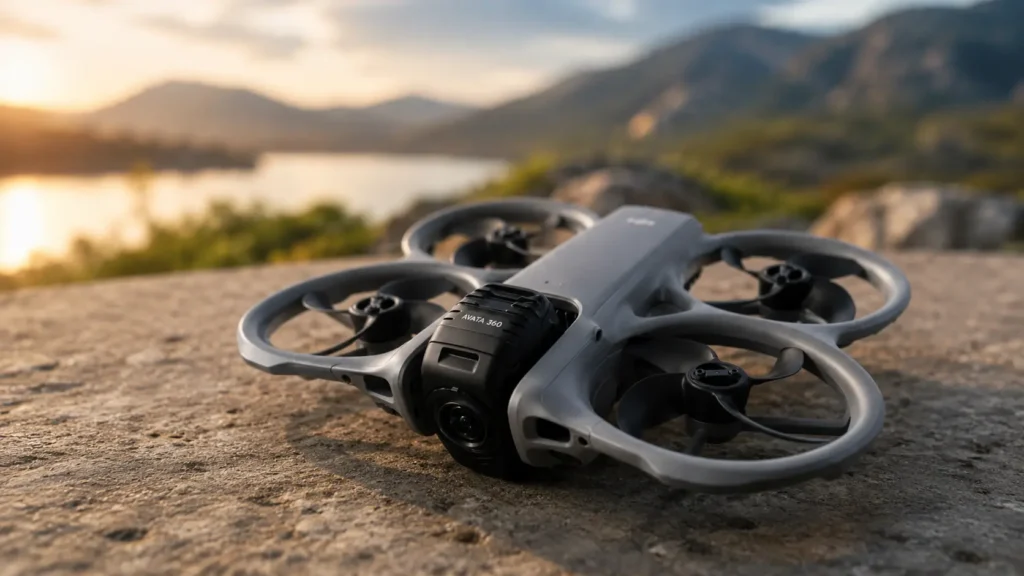
The first thing you notice about the DJI Avata 360 is just how solid it feels. Built in the cinewhoop style, it features fully enclosed propeller guards that protect both the drone and anyone or anything nearby. This design makes it far safer to fly indoors, around people, or in tight spaces compared to open-prop drones. The guard design also means you can clip a tree branch or bump a wall and keep flying, something an unprotected drone would struggle t o survive.
It measures 246 x 199 x 55.5mm and tips the scales at around 455 grams with the battery installed. That weight does put it above the 250g threshold that triggers drone registration requirements in many countries, including the EU and UK, so you will need to sort out the relevant paperwork before flying.
The camera system uses a clever rotating mechanism. When the drone is sitting on the ground, both lenses face forward and backward, with one lens naturally shielded from the surface. Once it takes off, the entire camera block rotates 90 degrees so one lens faces upward and the other faces downward, capturing the full spherical view.
When landing, this rotation reverses automatically to protect the lower lens. It is an elegant solution to a very real problem with 360 cameras. Two small rubber feet under the camera module also help cushion any contact.
Both lenses are user-replaceable, which is a smart move. Anyone who has ever scratched a 360 camera lens knows how easily it happens, and being able to swap them yourself without a service center is a meaningful quality-of-life feature. The replacement kit comes with the necessary tools.
There is also a microSD card slot and a USB-C port on the left side of the body, tucked behind a rubber cover for protection. The drone comes with 42GB of built-in storage, expandable up to 1TB via microSD. One of the Fly More Combo packages includes a branded shoulder bag that fits the drone, controller, three batteries, goggles, and accessories all in one place.

Camera Capabilities
The camera system on the Avata 360 is what makes this drone genuinely interesting. Both lenses use 1/1.1-inch square CMOS sensors with 64 megapixels each and an f/1.9 aperture, giving each lens a 200-degree field of view. When both are active and stitched together, you get full 360-degree coverage with no blind spots, and the drone itself is invisible in the final footage thanks to DJI’s stitching algorithms.
In 360 mode, the drone records at up to 8K (7680×3840) at 60fps. You can also shoot in 6K at 60fps if you want slightly smaller files with less of a processing load. For still photography, both sensors combine to produce 120-megapixel spherical images at a resolution of 15,520 x 7,760 pixels. These are massive files, around 50MB per JPEG, but the level of detail is impressive, and you can zoom into a final shot and still retain meaningful clarity.
The drone also supports a single-lens mode, where the camera block rotates to point one lens forward, effectively turning it into a more conventional drone camera. In this mode it shoots up to 4K at 60fps in both 4:3 and 16:9 aspect ratios, and there is limited PTZ functionality.
It is worth noting that in single-lens mode the camera cannot compensate for roll, since the single-axis mechanical setup was designed for 360 use. This means that if the drone tilts to fight wind, your footage may look slightly Dutch-angled. It is manageable in calm conditions but something to keep in mind if you plan to use this mode heavily.
For video modes in single-lens, the drone supports up to 2.7K at 120fps for slow-motion capture, and the standard 4K options cover multiple frame rates from 24 up to 60fps. D-Log M is available as a color profile for those who want more flexibility during color grading in post-production.
The 360 footage captures outstanding dynamic range in good light, handling contrasty scenes well when shooting in D-Log M. Low-light performance is more limited, as the electronic stabilization used in 360 mode requires slower shutter speeds that can introduce motion blur in darker environments.
This is a known limitation of the sensor format and stitching process rather than a flaw specific to the Avata 360; it applies equally to 360 action cameras in the same price range.
Stitching quality is generally very good, and at normal flying distances most viewers will not notice the seam between the two lenses. However, if you fly very close to objects or make sharp, sudden directional changes, the stitch line can become visible as the drone’s angle shifts rapidly. DJI has addressed this in firmware updates, but smooth, steady flying still gives the best results.
Performance
The Avata 360 is genuinely fun and capable in the air. It reaches a top speed of around 18 meters per second in Sport mode, which is fast enough for most action-tracking scenarios. Cinema mode keeps things slow and deliberate for controlled shots, while Normal mode offers a sensible middle ground with obstacle avoidance still active. Sport mode disables obstacle avoidance entirely, so it is best saved for open areas.
The obstacle avoidance system combines front-facing vision sensors, a LiDAR unit for better detection in low-light conditions, and downward Time-of-Flight sensors. In practice, the system handles most common obstacles reliably during Normal mode flying, though it is less omnidirectional than the dedicated sensor arrays found on DJI’s higher-end drones like the Air and Mavic lines. In single-lens mode, only front and downward sensing is active, so flying near obstacles to the sides or rear requires more caution.
Battery life sits at around 23 minutes under optimal conditions and closer to 18-19 minutes under real-world flying in moderate wind while actively recording. That is about the same as the Avata 2 before it, which is acceptable but not exceptional. For extended shoots, the Fly More Combo with three batteries is the smarter buy.
The drone also includes DJI’s OcuSync 4.0+ transmission system, which offers a theoretical maximum range of 20 km in low-interference conditions. In real-world suburban or urban environments, that number drops significantly, and one reviewer’s range test in open conditions showed the connection holding solid up to around 3.7km before signal degradation. For everyday creative use, the transmission is more than adequate.
Wind resistance is rated at Level 5, around 10.7 meters per second, which held up well in real testing at wind speeds above 20mph. The heavier weight compared to sub-250g drones actually works in its favor here, since lighter craft tend to drift more noticeably in gusty conditions.
One point worth noting is noise. The Avata 360 is measurably louder than compact drones like the DJI Mini series, which is typical for larger cinewhoops with enclosed propellers. It is audible from several hundred meters away, so it is not a stealth option for wildlife shooting or sensitive environments.
Features
The Avata 360 comes loaded with intelligent flight features, and the list is genuinely competitive. ActiveTrack lets the drone automatically follow a subject at up to bicycle speeds, while Spotlight Free can orbit a subject or execute a rising “dronie” shot. QuickShots include Rocket, Dronie, Circle, Helix, and Boomerang modes for social-media-ready clips. These work best when using the RC 2 controller, as the Goggles mode does not support tracking features.
Return to Home is automatic when the battery drops low, and obstacle avoidance stays active during the RTH sequence. The drone also supports FPV flying via the Goggles N3 headset and RC Motion 3 controller, where head tracking lets you look in any direction simply by turning your head. This is a genuinely immersive way to fly, though it takes time to get comfortable with.
An “Easy Acro” mode provides some cinewhoop-style maneuverability without requiring full manual control. For riders coming from dedicated FPV freestyle drones, this may feel limiting since there is no true manual mode available. For the majority of content creators, though, it offers enough playfulness without the steep learning curve of actual freestyle flying.
The 360-degree camera itself functions as a virtual gimbal in post. Since every direction is captured simultaneously, the entire job of “aiming the camera” is moved from flight time to the editing suite.
This is one of the most significant practical advantages of the drone: you can focus on positioning and flying rather than framing. This also means a solo operator can fly and capture far more usable footage per session than they could with a conventional drone.
Controller and Pricing
One of the DJI Avata 360’s biggest advantages over its only competitor is flexibility in how you fly it. You can pair it with the DJI RC 2 screen controller for a familiar, traditional drone experience. You can add the Goggles N3 and RC Motion 3 for a fully immersive FPV setup. Several other DJI controllers are also compatible, including the RC-N2 and RC-N3, meaning many existing DJI users can start flying with gear they already own after a simple firmware update.
The drone alone costs around $549 (approximately £409), ideal for those who already own compatible DJI accessories. The Avata 360 with the DJI RC 2 controller runs around $859.
DJI also designed the post-production workflow around two free tools. DJI Studio for Mac and Windows is the dedicated 360 editor where you can reframe shots, adjust field of view, apply effects like Asteroid or Ultra Wide, add keyframe animations, and export flat video. The DJI Fly app for iOS and Android handles firmware updates, quick footage preview on the controller screen, and even includes an AI-powered One Tap Edit feature that automatically trims and packages your footage with music and effects.
Final Verdict
The DJI Avata 360 does something genuinely new in the drone world, and it pulls it off with the kind of polish you’d expect from DJI. The 8K 60fps 360 video leads its category, the 120MP stills are seriously impressive, and the ability to fly first and frame later is a real workflow upgrade for solo creators. Add in the flexible controller options, solid build quality, and pricing that significantly undercuts the only real competition, and it makes a strong case for itself.
That said, it is not a drone for every shooter. Single-lens mode has roll limitations in wind, low-light 360 performance is average, and editing 8K spherical footage demands a capable computer and some learning curve. The 455g weight also puts it in the regulated category in most markets. But if you want aerial footage that genuinely looks different from everything else out there, the Avata 360 is the best tool for that job right now.
Read More: DJI Mini 4K vs DJI Mini 3