
If you have spent any time following drone news over the past year, you have probably run into the term “fiber optic drone” more than once. It sounds technical, and in some ways it is, but the core idea behind it is actually pretty simple once you break it down. In this guide we will walk through exactly what a fiber optic drone is, how it works, why it has become such a big deal in modern drone warfare, and where the same technology could end up being useful outside of a battlefield.
What Is a Fiber Optic Drone
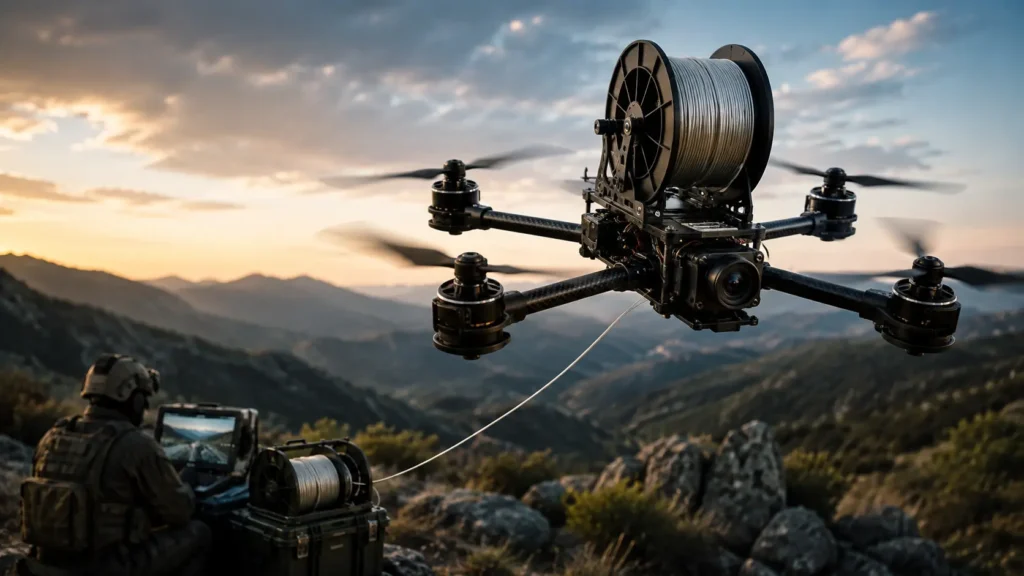
A fiber optic drone is an unmanned aerial vehicle, usually a first person view (FPV) drone, that is guided and controlled through a physical fiber optic cable instead of a radio signal. Rather than sending control commands and video feed through the air where they can be picked up, jammed, or spoofed, everything travels down an ultra thin strand of optical fiber that trails behind the aircraft as it flies.
These cables typically run somewhere between 5 and 20 kilometers, though some prototypes have pushed that range out to as far as 50 kilometers. The tether is thinner than fishing line and almost impossible to spot with the naked eye once the drone is airborne, which is part of what makes this technology so appealing for both military and industrial use cases.
How a Fiber Optic Drone Works
The mechanics behind a fiber optic drone are fairly straightforward once you understand the main components.
Spool fed tether: A lightweight drum or spool holding several kilometers of micro fiber is strapped either to the drone itself or set up at the ground station. As the drone flies, the cable unwinds dynamically, letting out just enough slack to keep up with the aircraft without snapping the connection.
Physical data link: Instead of relying on radio frequency signals, both control commands and the high definition video feed travel through the glass fiber. This gives the operator a direct, wired connection to the drone at all times.
No RF signature: Because there is no radio transmission happening between the drone and the operator, there is nothing for jammers or electronic warfare systems to detect or disrupt. The drone essentially becomes invisible to any system built to hunt for wireless signals.
This setup is what allows a fiber optic drone to operate reliably in environments where traditional RF controlled drones would lose their connection almost immediately.
Major Advantages of Fiber Optic Drones
There are a few reasons this technology has spread so quickly, especially in contested environments.
- Jam proof communication. Since there is no wireless signal involved, standard GPS and RF jamming tools have no effect on a fiber optic drone. This is arguably the single biggest reason the technology exists.
- Crystal clear video feed. A physical fiber connection delivers extremely low latency, high definition video all the way until the tether runs out, with none of the interference or dropouts that can plague RF links.
- Harder to detect. Traditional electronic warfare systems scan for wireless signals to locate drone operators. A fiber optic drone gives off no such signature, making it much harder to trace back to its source.
Key Limitations of Fiber Optic Drones
No technology is perfect, and fiber optic drones come with their own set of trade offs.
- Physical vulnerability. The cable itself is the weak point. If it gets snagged, tangled, or physically cut, the connection is severed instantly and the drone becomes uncontrollable.
- Weight and drag. Carrying kilometers of spooled cable adds real weight, which means larger frames, bigger motors, and stronger batteries are needed just to keep the aircraft stable and mobile.
- Environmental obstacles. Dense terrain like tree branches, fences, or tight urban corridors can snag or snap the trailing cable, especially during sharp turns or fast maneuvers.
Fiber Optic Drone Range Explained
Most fiber optic drones in active use today carry somewhere between 5 and 20 kilometers of cable, which is enough for most tactical or reconnaissance missions. Manufacturers have been pushing those limits though, and some newer prototypes have demonstrated spools capable of reaching up to 50 kilometers. The tradeoff is always the same: more cable means more weight, which eats into flight time, speed, and overall maneuverability. Engineers are constantly balancing spool size against payload and battery life to find the sweet spot for a given mission.
Can a Fiber Optic Drone Be Jammed
No, at least not through conventional means. Since a fiber optic drone does not rely on radio waves to receive commands or transmit video, standard RF jammers and GPS spoofers simply have nothing to interfere with. This is the defining feature of the technology and the main reason it has become so widely adopted in electronic warfare heavy environments. The only realistic way to stop one is to physically locate and cut the cable, which is far more difficult than jamming a wireless signal.
Can a Fiber Optic Drone Be Detected
Detecting a fiber optic drone is significantly harder than detecting a standard RF controlled drone. Because it emits no wireless signal, direction finding equipment and RF scanners cannot pick it up the way they would with a typical FPV drone. That said, a fiber optic drone is not invisible. It can still be spotted visually, tracked by acoustic sensors, or picked up by thermal and radar systems depending on altitude, size, and environment. The stealth advantage applies specifically to electronic detection methods, not physical ones.
Fiber Optic Drones vs Radio Controlled Drones
| Feature | Fiber Optic Drone | Radio Controlled Drone |
| Signal type | Physical fiber cable | Wireless RF signal |
| Jamming resistance | Immune to RF jamming | Vulnerable to jammers and spoofers |
| Video quality | Consistently high, low latency | Can degrade with distance or interference |
| Max range | Limited by cable length, up to ~50 km | Limited by transmitter power and line of sight |
| Weight | Heavier due to spool and cable | Lighter, easier to maneuver |
| Detectability | No RF signature, harder to trace | Detectable via RF direction finding |
| Physical risk | Cable can snag or be cut | No physical tether to worry about |
Fiber Optic Drones Beyond the Battlefield
Most of the attention fiber optic drones have gotten so far comes from their role in modern conflict, particularly in Ukraine, where both sides have leaned on the technology heavily to get around electronic warfare defenses. But the same core idea, an unjammable, high bandwidth physical link between an aircraft and an operator, has real potential outside of military use.
Industrial inspection is one obvious fit. Power line inspections, pipeline monitoring, and confined space surveys often happen in areas with heavy electromagnetic interference or where a dropped RF connection could mean a lost or damaged drone. A tethered fiber optic connection solves that problem directly, and it also means the drone can operate without draining its battery on a wireless transmitter, since data moves through the cable instead.
If you are researching FPV drones for other reasons, our complete guide to choosing an FPV drone covers the fundamentals that apply whether you are flying RF or tethered setups. And if range and connectivity limitations are a concern for your use case, it is also worth reading through our breakdown of hidden costs of drone ownership, since specialized hardware like fiber optic systems tends to come with a steeper price tag than a standard consumer drone.
Final Thoughts
A fiber optic drone trades a bit of weight and physical vulnerability for something that, until recently, was considered nearly impossible: a genuinely unjammable, high definition wireless connection. That tradeoff has made it one of the most talked about developments in drone technology over the past two years, and it is not hard to see why. Whether the future of fiber optic drones stays mostly on the battlefield or expands into industrial and commercial applications, the underlying concept of trading a wireless link for a physical one is likely here to stay.
For further reading, the Wikipedia entry on fiber optic drones covers the origin and history of the technology in more depth, the Atlantic Council’s analysis breaks down its role in the Russia Ukraine conflict, and Taifun’s technical guide goes deeper into the hardware and spool mechanics if you want a more engineering focused perspective.