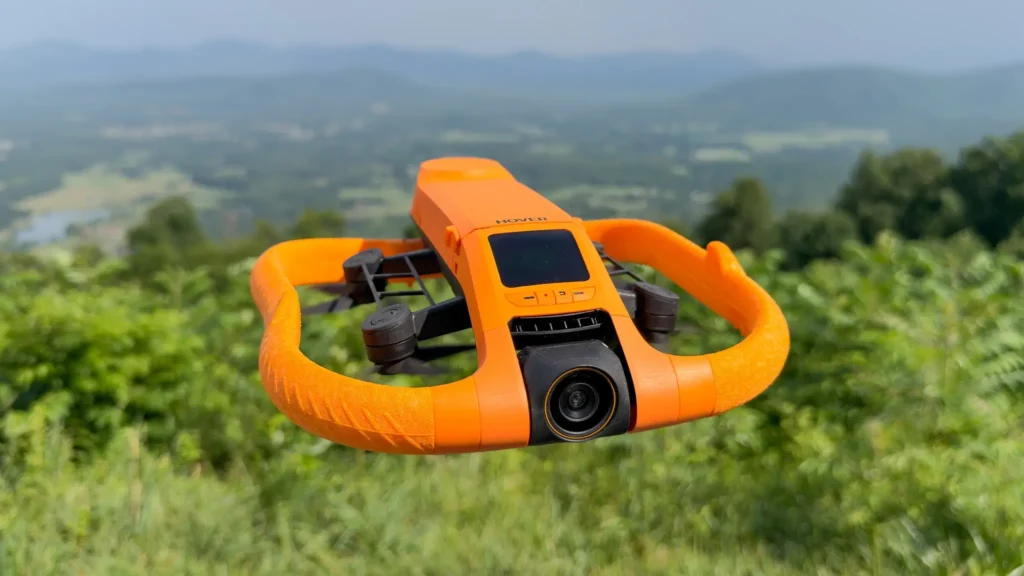

The DJI Avata 360 is one of the most-awaited drone launches in years, and for good reason. It combines two worlds that have never shared a single airframe before: the thrilling, immersive experience of FPV (First-Person View) flying and full spherical 360-degree capture in stunning 8K resolution. This is not just another drone upgrade. It is an entirely new category.
This guide gathers everything confirmed, leaked, and officially announced about the Avata 360, including specs, pricing, key features, design details, and how it compares to the competition. Whether you are a serious aerial cinematographer or a content creator looking to improve, here is what you need to know.
At a Glance: Key Facts
| Detail | Information |
|---|---|
| Official Name | DJI Avata 360 |
| Category | 360° FPV Camera Drone |
| China Launch | March 26, 2026 |
| Global Launch | April 9, 2026 |
| Starting Price | €459 (Drone Only) $499 (Drone Only) |
| Video Resolution | 8K @ 60fps – 360° Spherical |
| Sensors | Dual 1/1.1-inch, 64 MP CMOS |
| Flight Time | ~18–23 minutes (real-world) |
| Obstacle Avoidance | Omnidirectional + LiDAR |
| Main Competitor | Insta360 Antigravity A1 |
Background: Why This Drone Matters
For years, drone videographers have dealt with a frustrating choice: opt for a powerful FPV drone that offers dynamic, cinematic flights, or attach a 360-degree camera to a standard drone and accept the limitations that come with it. DJI’s Avata 360 ends this compromise.
This is DJI’s first 360-degree drone designed specifically for this purpose. The 360-degree camera system is not an accessory or an afterthought; it is central to the aircraft’s design. With FPV flying capability and DJI’s top-notch transmission technology, this product challenges everything else available on the market.
It specifically targets the Insta360 Antigravity A1, the world’s first true 360-degree drone. DJI enters this niche later but brings much more depth to its ecosystem, better obstacle sensing, and crucially, a lower price.

Design & Build Quality
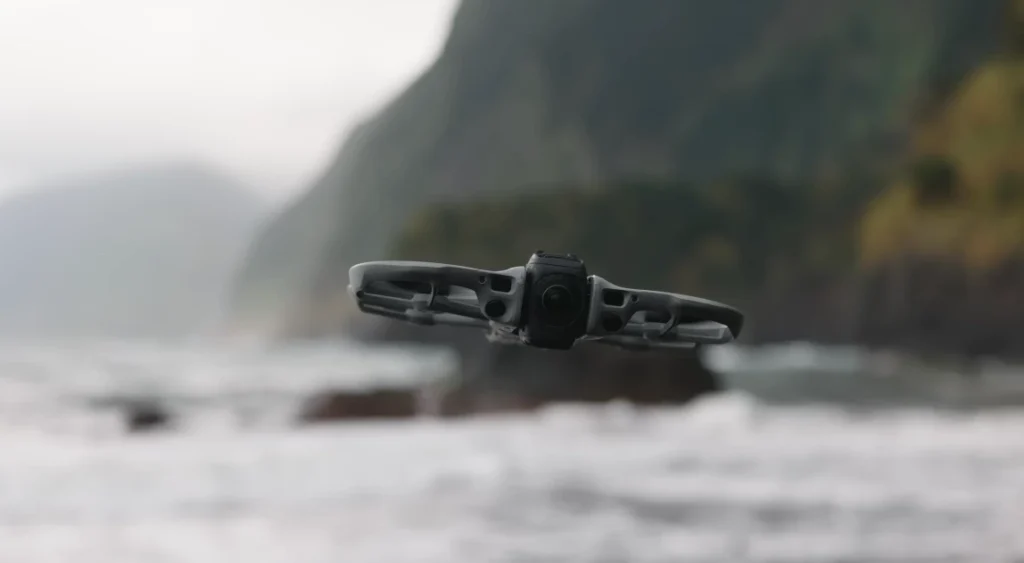
The Avata 360 is larger than the Avata 2 and smaller than the Neo 2 in terms of overall size. It is slightly wider at the front because of the 360 camera bump, but is slimmer overall; the Avata 2 is taller. It is also noticeably bigger than the original Avata 1.
The protective prop guard cage covers all blades on every side. This feature allows for close flying without the risk of hitting the propellers. It is vital for capturing the intimate cinematic shots the Avata 360 aims for. The build quality stands out as top-tier. The design shows DJI’s focus on both looks and toughness.

Camera & Video Specifications
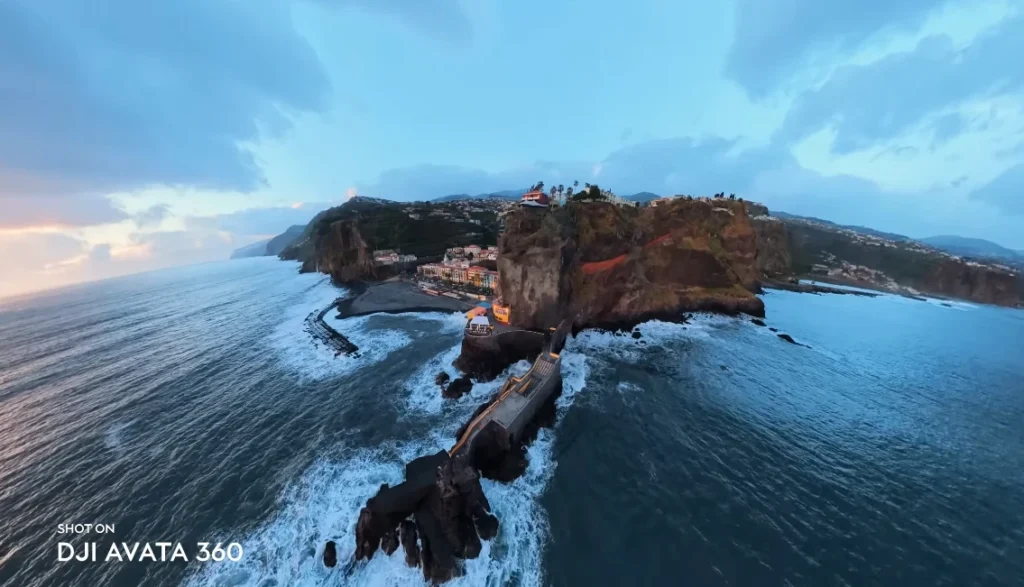
8K 60fps, A First for 360 Drones
The main feature of the Avata 360 is its dual fisheye camera system. It captures full spherical 360-degree video at 8K resolution and 60 frames per second. To grasp its significance, consider this:
- 8K at 30fps is already impressive for a drone of this size.
- 8K at 60fps on a consumer drone doesn’t exist anywhere else right now.
- Higher frame rates offer smoother motion, improved slow-motion capabilities, and much more flexibility in post-production.
- When you reframe 360 footage into a standard flat video, the extra resolution helps keep your final output sharp, even after cropping.
The two sensors are 1/1.1-inch CMOS units, each with a resolution of 64 megapixels, providing a 200-degree field of view per lens. Together, they create a seamless spherical image. These sensors are large by action drone standards, which results in better low-light performance, a wider dynamic range, and higher overall image quality.
| Camera Spec | Detail |
|---|---|
| Video Resolution | 8K @ 60fps (360° Spherical) |
| Sensors | Dual 1/1.1-inch CMOS, 64 MP each |
| Field of View | 200° per lens (full sphere combined) |
| Color Profiles | Normal (D-Log M) |
| Stabilisation | RockSteady 3.0+ / HorizonSteady |
| HDR | Yes |
| Still Photos | Up to ~120 MP spherical panoramas |
| Lens Mount | Replaceable fisheye lenses (€21 each) |
The Rotating Camera System
One of the smartest engineering choices in the Avata 360 is the rotating dual-fisheye mount. It addresses a key issue: when a 360 drone lands, both exposed fisheye lenses point downward, putting them at risk of scratches or cracks.
DJI’s solution is simple: the camera rotates. During takeoff and landing, one lens faces upward, away from the ground, while small rubber feet protect the bottom. Once the drone is in the air, the camera rotates back to its full 360-degree capture position. No other drone on the market does this.
With user-replaceable lenses available for just €21 each, any lens damage-usually an expensive fix on traditional 360 cameras-becomes a minor inconvenience on the Avata 360.
Single Lens Mode
The Avata 360 is more than just a 360 drone. It can switch to a single-lens mode that allows it to work like a standard FPV camera drone. In this mode, it captures footage from a forward-facing angle without any spherical stitching, giving you clean, conventional footage. This means you essentially get two drones in one:
360 Mode: Full spherical capture for immersive content, tiny planet effects, reframable footage, and virtual camera work.
Single Lens Mode: Traditional FPV-style footage with a standard forward-facing perspective.
This flexibility is important. You do not have to carry both an FPV drone and a 360 drone on a shoot. The Avata 360 can handle both situations.
Flight Performance & Intelligent Features
Omnidirectional Obstacle Avoidance
One of the main criticisms of the DJI Avata 2 was its lack of obstacle sensing. Flying quickly and close to objects without protection is stressful, especially when your camera costs hundreds of euros.
The Avata 360 tackles this issue directly with full omnidirectional obstacle avoidance. It has sensors on all sides that continuously scan the surroundings and alert the pilot, or automatically stop the drone, when an obstacle is detected. This is a major safety improvement, especially for creators flying in complex environments.
LiDAR Sensor
In addition to the standard camera-based obstacle sensing, the Avata 360 adds a LiDAR sensor, which measures distance using lasers. This technology addresses key areas where visual sensors fall short:
- Low-light environments where cameras have difficulty seeing clearly.
- Featureless surfaces like white walls, open sky, or uniform terrain.
- Precision hovering in challenging conditions.
LiDAR is not typically included in consumer drones. Its inclusion here shows that DJI is positioning the Avata 360 as a serious professional tool, rather than just a hobbyist product.
Controller & Ecosystem Compatibility
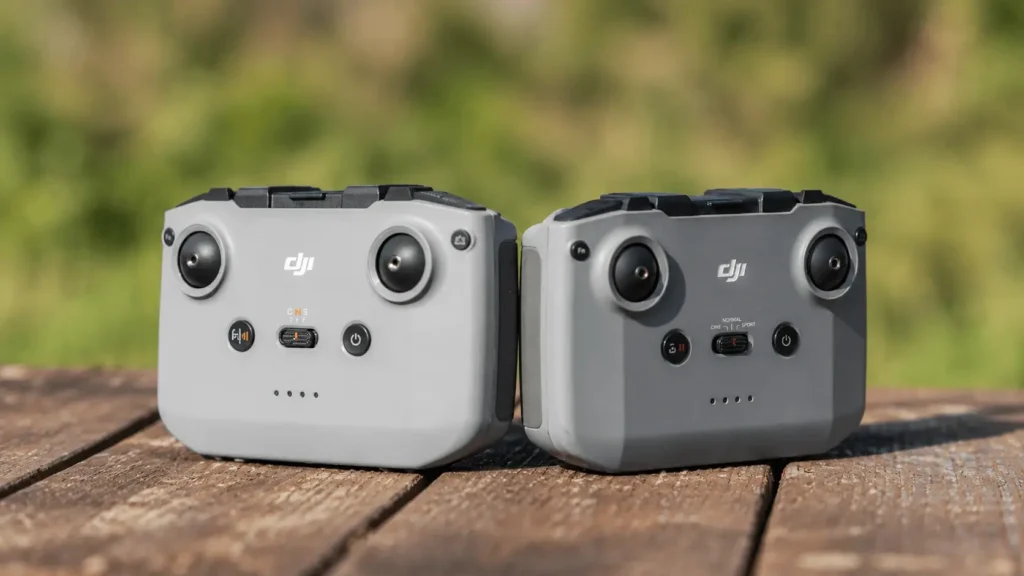
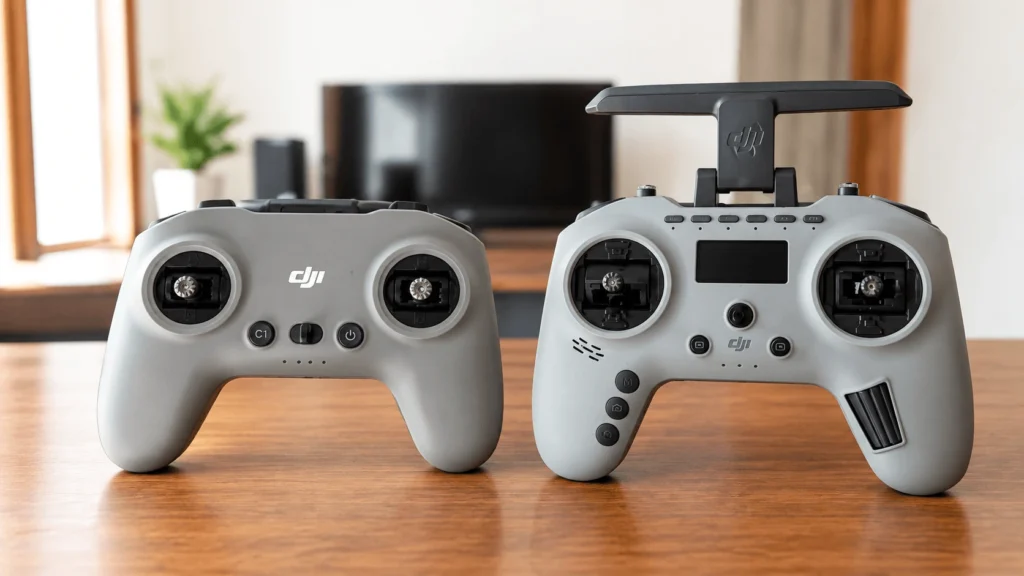
The Avata 360 works well with DJI’s current FPV ecosystem. If you already have an RC2 controller, you can buy the drone-only version and start flying right away; there’s no need to buy new equipment.
| Device | Compatible |
|---|---|
| DJI RC2 Controller | Yes – Drone Only SKU available |
| DJI Goggles N3 | Yes |
| DJI Goggles 3 | Yes |
| DJI RC Motion 3 | Yes |
This wide compatibility is one of DJI’s biggest strengths compared to its competitors. The Antigravity A1 needs its own special hardware. The Avata 360 connects easily with controllers and goggles that many DJI users already possess.
Pricing & Packages
The leaked European pricing shows the Avata 360 is surprisingly affordable for a top-tier 360 drone. For comparison, the Insta360 Antigravity A1 costs about $1,599 USD. The Avata 360 is priced much lower:
| Package | Price (EUR) |
| Drone Only | €459 |
| Fly More Combo (with RC2) | €939 |
| Motion FlyMore (with Goggles N3) | €939 |
| Premium Combo (RC2 + Goggles) | €1,159 |
| Extra Battery | €79 |
| Replacement Lens (per lens) | €21 |
| Propellers | €9 |
DJI Avata 360 vs. Insta360 Antigravity A1
The Antigravity A1 was the world’s first 360-degree drone, announced in mid-2025. It deserves credit for starting the category. However, the Avata 360 comes with several clear advantages.
| Feature | DJI Avata 360 | Antigravity A1 |
|---|---|---|
| Video | 8K 60fps | 8K 30fps |
| Obstacle Avoidance | Omnidirectional + LiDAR | Basic |
| Single Lens Mode | Yes | No |
| Transmission | DJI O4 (class-leading) | Standard |
| Controller Ecosystem | RC2, Goggles 3, N3, Motion 3 | Own hardware required |
| Lens Replacement | User-replaceable, €21 each | Manufacturer repair |
| Starting Price | ~€459 / ~$599 | ~$1,599 |
For creators who have already invested in the Antigravity ecosystem, switching is not an easy decision. The A1 has been around longer, so it has more user experience and a stronger track record. The Avata 360 appears better on paper, but real-world testing will provide the final answer.
Who Is the DJI Avata 360 For?
The Avata 360 is designed for content creators, not racing pilots. Here are the main beneficiaries:
- Aerial cinematographers who want to reframe shots easily in post-production.
- Social media creators who need lively, immersive footage for Reels, TikTok, and YouTube Shorts.
- Travel and adventure creators are looking for one drone that can do it all.
- Current DJI FPV users who want to add 360 features without switching ecosystems.
- Professionals who require reliable obstacle avoidance and LiDAR accuracy in complex shooting situations.
If you are a serious FPV freestyle or racing pilot, the Avata 360 may not suit you. Its design, weight, and features focus on cinematic capture, not competitive flying. A lighter, more agile FPV rig will still outperform it in flight performance.
Storage & Data Handling
8K 360-degree footage creates very large files. Based on file size data seen in leaked RC2 footage, the Avata 360 is expected to come with 128 GB to 256 GB of internal storage, along with an SD card slot for more capacity or backup.
DJI stitches the footage on board, which greatly simplifies the editing process. You won’t need specialized software just to stitch your spherical footage before you can start editing. However, you will still need a powerful computer for 8K post-production work.
Complete Specifications Summary
| Specification | DJI Avata 360 |
|---|---|
| Video | 8K @ 60fps, 360° Spherical |
| Sensors | Dual 1/1.1-inch CMOS, 64 MP each |
| Field of View | 200° per lens |
| Color Profile | 10-bit D-Log M |
| Stabilisation | RockSteady 3.0+ / HorizonSteady / 360° Digital |
| Single Lens Mode | Yes – standard forward-facing FPV mode |
| Obstacle Avoidance | Omnidirectional + LiDAR |
| GPS | Up to 36 satellites |
| Battery Capacity | 38.6 Wh |
| Flight Time | ~18–23 min real-world |
| Camera System | Dual fisheye on rotating mount |
| Lens Replacement | User-replaceable, €21 each |
| Storage | 42 GB internal + SD card slot |
| Weather Resistance | Yes (not waterproof) |
| Controllers | RC2, Goggles N3, Goggles 3, RC Motion 3 |
| China Launch | March 26, 2026 |
| Global Launch | April 9, 2026 |
| Starting Price | €459 (Drone Only) |
Table of Contents
Final Verdict
The DJI Avata 360 is a real step forward. It’s not just an upgrade; it’s a new look at what a 360-degree drone can do. By mixing FPV flying with 8K spherical capture, all-around obstacle avoidance, LiDAR sensing, flexible single-lens mode, and DJI’s top-notch ecosystem, it makes a strong case for being the most versatile camera drone ever made.
The pricing is competitive. The features are top-tier. The compatibility with the ecosystem is unmatched. If the real-world performance matches the specifications, the Avata 360 could become the go-to tool for aerial content creation in 2026.
We’ll get a clearer picture when independent reviewers have a chance to test it after its launch. It will launch on March 26th in China and then on April 9th globally. That’s when the real story begins.
Read More: SJRC F11 Pro 4K Camera Drone Review