
Most beginners getting into FPV start in the wrong place. They focus on the drone when the decision that really matters should be the FPV radio. Because you are not just choosing a controller, you are choosing an entire ecosystem. And if you get that wrong, it can cost you later. So before you buy anything, there are five key decisions you need to think through carefully.
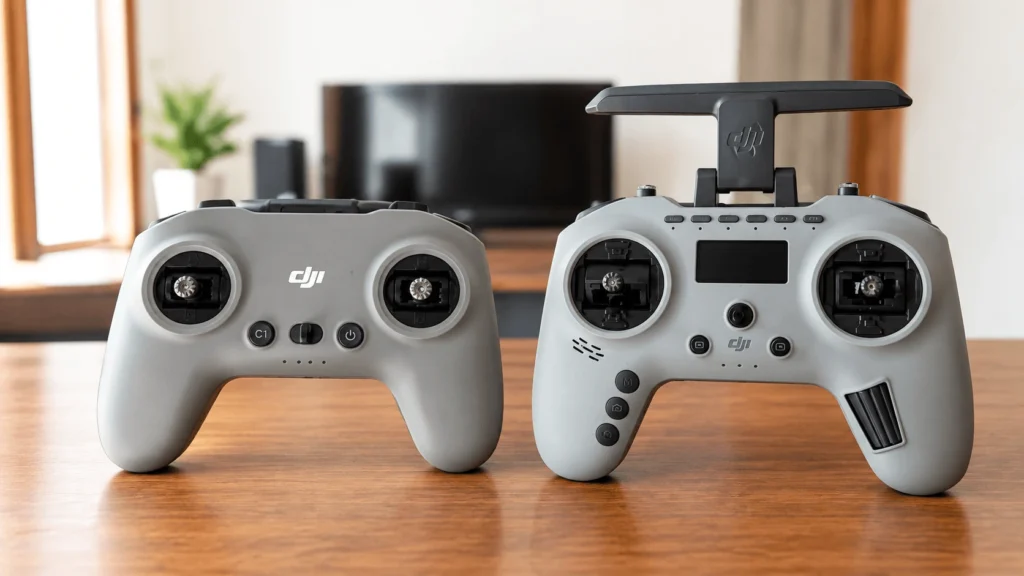
If you are coming from something like the DJI Avata series, you most likely already have something like the DJI RC 3. That is actually a great starting point for this conversation, so let us begin there.
Table of Contents
Choose Your Ecosystem First
This is the most important decision you will make because it determines what drones you can actually fly.
If you are coming from DJI, you are most likely using something like the DJI RC 3 with the DJI system. The big advantage here is that everything is built in. It is plug and play, quick to set up, and easy to get flying. If you already own it, there is no need to spend extra money on another FPV radio. However, there is one downside to this, and we will come back to that later.
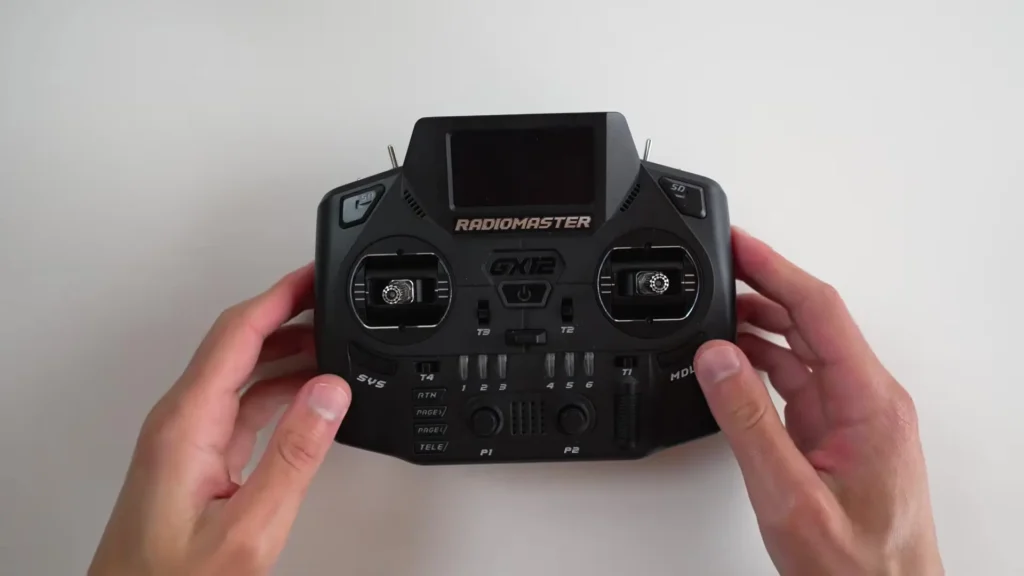
Now let us look at ELRS, which is what most FPV pilots are using today. It is widely supported, works with a huge range of drones, and gives you the most flexibility. The RadioMaster TX12 with built in ELRS is a great example of this.
It gives you more control, more options, and generally more functionality than something like the DJI controller. The trade off is that it is not as plug and play. You need to set things up yourself, and you will also need a receiver on your drone.
Then there is Crossfire. It has been around longer and is known for reliability, especially for long range flying. A lot of experienced pilots still use it. But these days, most people are choosing ELRS because it is more flexible and offers more options. Some radios also support external modules, which means you are not completely locked in. But as a beginner, it is still better to choose the right ecosystem from the start.
Size and Ergonomics
Once you have chosen your ecosystem, the next step is choosing a controller that feels right to use. This mostly comes down to size and ergonomics.
Gamepad style radios like the DJI RC 3 and the TBS Tango 2 are smaller, lighter, and easier to travel with. They take up far less space in your bag and feel more familiar, especially if you are used to console controllers. The downside is they usually have fewer switches.
Mid size radios like the RadioMaster TX12 offer a more balanced option. They are still relatively compact but come with more features and better overall control. Full size radios like the RadioMaster TX16S give you the most switches and control options, but they are much larger and less portable.
At the end of the day, this decision comes down to size and comfort. You want something that feels good in your hands because that is what you will be using every single time you fly.
Gimbals and Switches
Size and ergonomics are important, but the next thing to think about is the controls themselves, specifically your gimbals and switches. This part works closely with the size of your FPV radio because not all radios are built the same.
The main thing to look at here is the gimbals, which are what control your movement. Cheaper radios tend to use lower quality potentiometer gimbals. These use traditional resistors found in older radios, which can feel less precise over time.
Most modern radios now use Hall effect gimbals, which are more accurate and do not wear down in the same way. Some radios also let you upgrade the gimbals later, which is worth considering if you want to improve your setup over time.
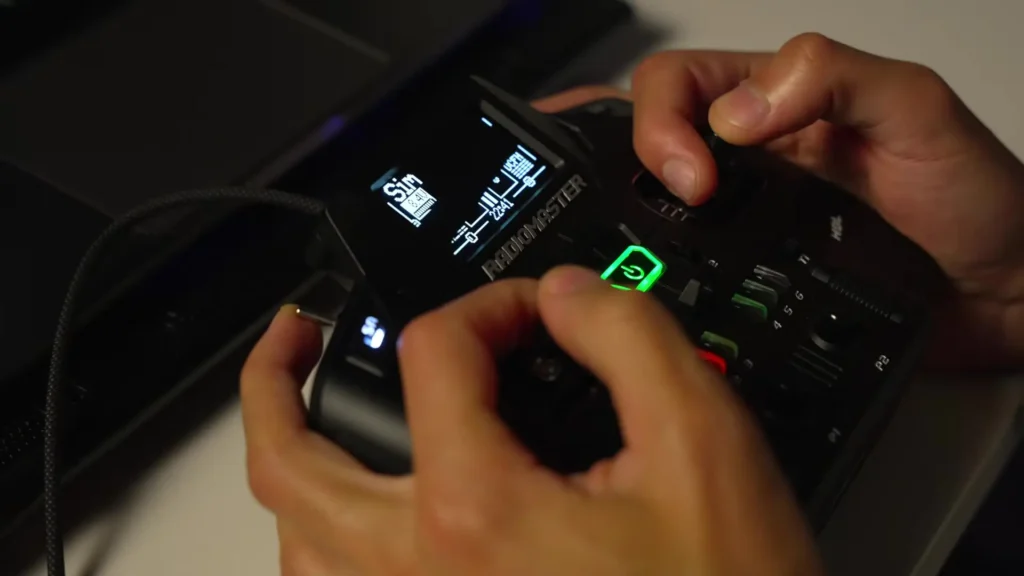
There are also different gimbal sizes depending on the radio, as well as foldable gimbals that are normally sold at a premium because they make the radio more compact and better for travel. There is a noticeable difference in feel and performance. After playing on the simulator with both the DJI RC 3 and the GX12, the RadioMaster GX12 is noticeably more precise when it comes to control.
When it comes to switches and buttons, gamepad style radios usually use buttons, which keeps things compact and travel friendly. Larger radios tend to have more traditional switches, which give better feedback and more control, but they stick out more and are easier to damage if you are not careful. Some radios even let you customize or swap out switches depending on your preference.
For beginners, you do not need loads of switches. You just need enough for basic functions like arming, flight modes, and a beeper. So do not overthink this part. Just make sure the radio feels solid and does what you need it to do.
Read More: Best FPV Simulator for Beginners in 2026
Range, Power, and Frequency
Some FPV radios come with built in batteries while others use external ones like 18650s, which are fairly common. Just be aware that depending on where you live, they can sometimes be harder to find or more expensive.
When it comes to output power, radios operate at different levels. Low power output between 10 and 25 mW is suitable for indoor tiny whoops or short range park flying. Medium output power between 100 and 250 mW is where most people will be flying, whether that is freestyle or general use, and it provides several kilometers of range.
High end output power from 500 mW to 1W and above is mainly used for long range or better signal penetration. Just know that flying at maximum output is not always needed or recommended, and it may actually be illegal in some places.
Most of the time you will be flying somewhere in the middle. And something important to understand is that power does not scale linearly. Doubling your output power does not double your range.
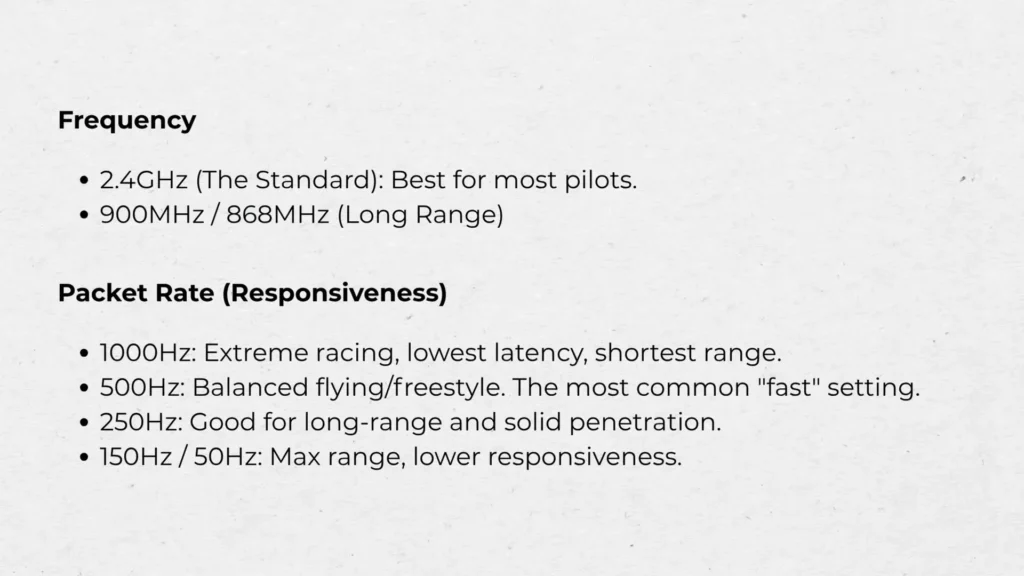
Alongside power, you have got frequency to think about. Most radios today run on 2.4 GHz, which is what the majority of pilots use. It is fast, responsive, and works well for most types of flying. Lower frequencies like 900 MHz, or 868 MHz in the EU, are typically used for long range.
They offer better penetration but are slower and usually not necessary unless that is the specific type of flying you want to do. For most people starting out, 2.4 GHz is more than enough. The key takeaway here is that range and power matter, but they should not be the main thing driving your FPV radio decision.
Read More: BETAFPV Pavo Pico 2 Review
Future Proofing Your Setup
Before getting into recommendations, there is one more thing to think about, and that is future proofing. Up until now, you have heard mentions of things like module bays and upgradeable gimbals. What this essentially means is having a radio that you can grow with. Because as technology changes, you do not want to be in a position where your radio becomes unusable and you have to replace it entirely.
For example, when starting out in FPV, Crossfire was the main system. Now ELRS is the standard. If most of your drones were running Crossfire and you chose a RadioMaster TX12 with a module bay, you could still fly both ELRS and Crossfire using one radio instead of needing two separate ones.
The same applies to gimbals. You can start with a more affordable radio and later upgrade to higher quality, more precise gimbals as you progress. So instead of spending everything upfront, you can improve your setup gradually over time. Even if you prefer the size and ergonomics of something like the Tango 2, sometimes it is worth choosing flexibility over personal preference.
When choosing your FPV radio, think about where you might want to go in the future, not just what works right now.
FPV Radio Recommendations for Every Budget


The One Thing Most Beginners Do Not Realize About DJI
Here is something most beginners never think about. Even though the DJI system is great and easy to use, it does not give you redundancy. What this means is that if you lose video signal while flying, there is a high chance you have also lost your control link, which means you could lose your drone entirely.
That is why it is recommended to separate your video feed from your radio link. With something like ELRS or Crossfire, even if you lose your video, you are still very likely to have control of the drone, giving you a much better chance of recovering it. That separation genuinely matters and can save you from losing an expensive piece of equipment.
Final Thoughts on Choosing Your First FPV Radio
You will not be able to tick every single box when choosing your FPV radio, and that is completely fine. You just have to compromise in some areas versus others. Focus on the ecosystem, the feel in your hands, the quality of the gimbals, and whether the radio can grow with you over time. Get those things right and you will have a solid foundation for your entire FPV journey.
Once you have chosen your radio, the next thing to look at is your first drone. If you are a beginner, the BetaFPV Pavo Pico 2 is well worth checking out as a great starting point.
Read More: DJI Avata 2 vs GEPRC Vapor-D5