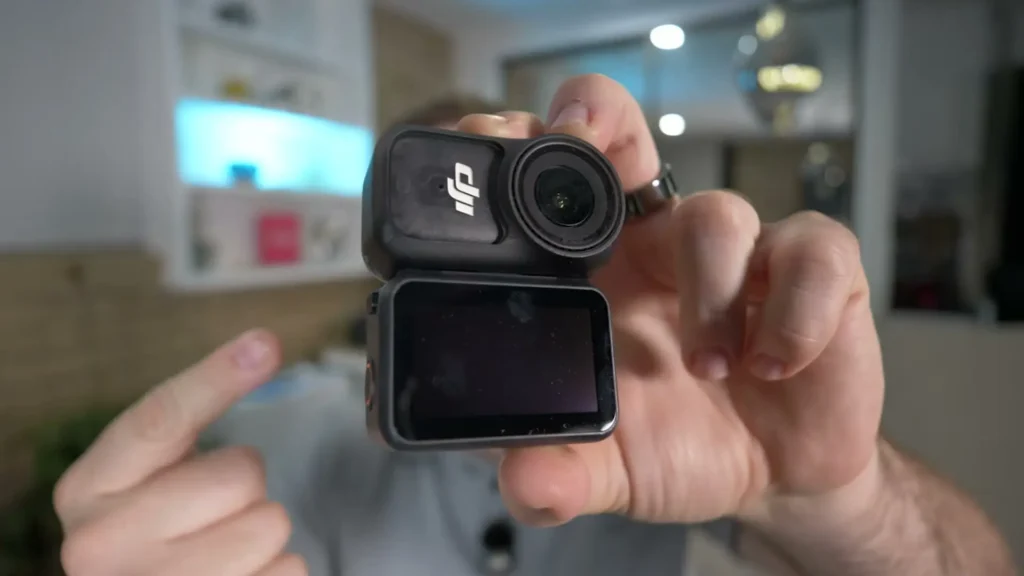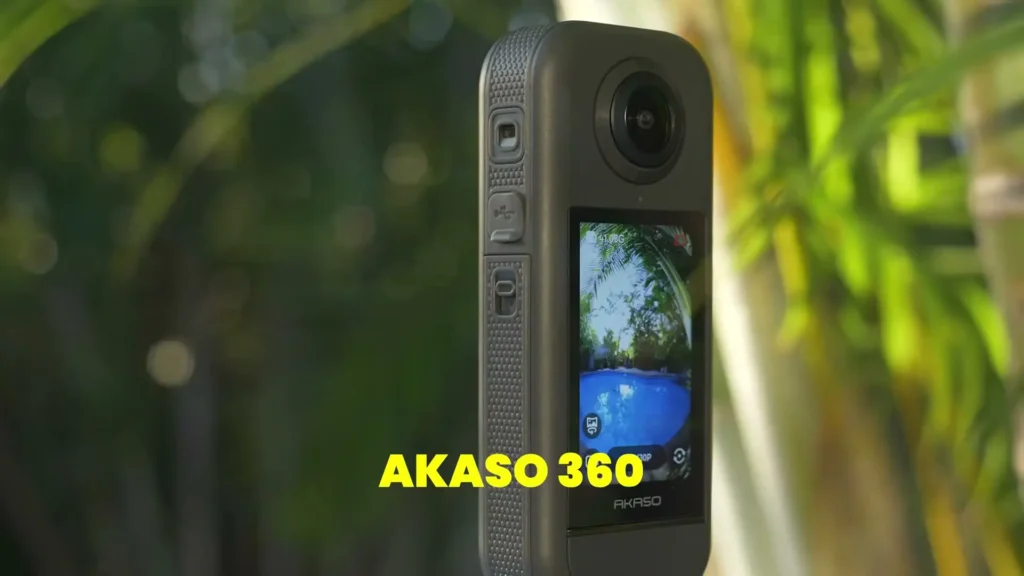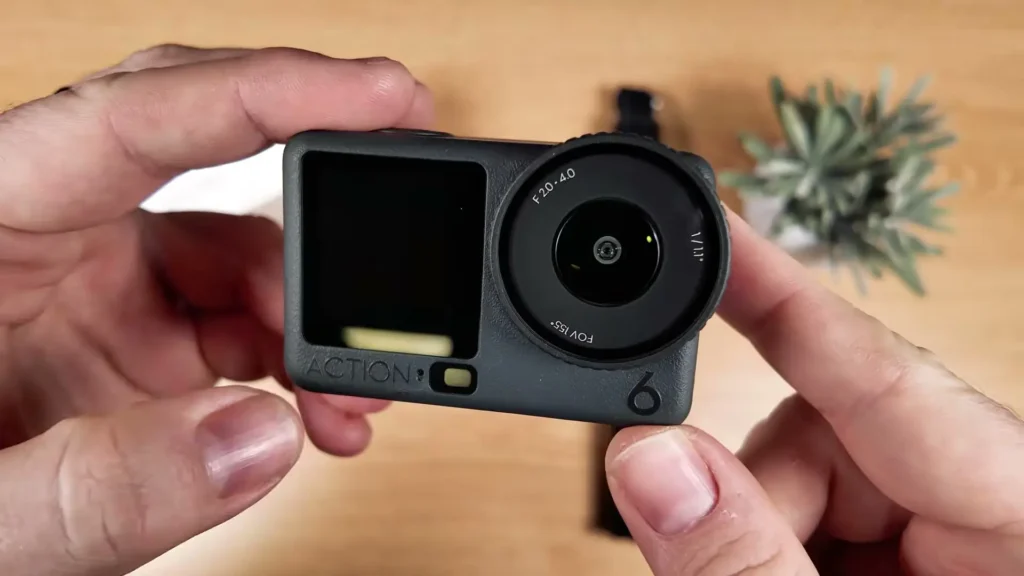

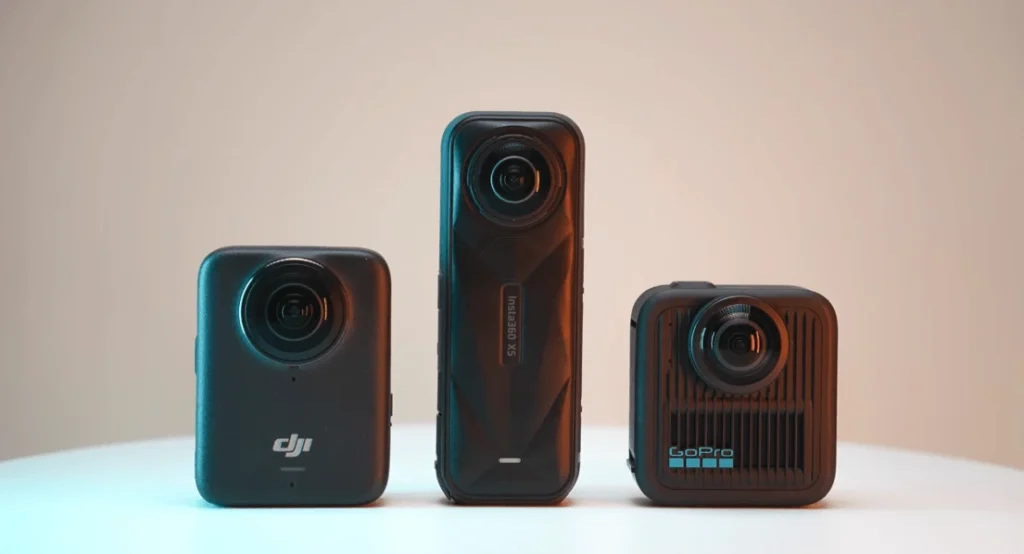
Action cameras are no longer the default choice for people who want to capture everything around them. 360 cameras record the whole scene and let you decide on framing later. Three models currently lead the category: the DJI Osmo 360, the Insta360 X5, and the GoPro Max 2. We tested all three across video, audio, shooting modes, software, design, battery life and price.
The short verdict: the DJI Osmo 360 delivers the best video quality and the best overall package. The Insta360 X5 is a strong alternative with superior battery life and replaceable lenses. The GoPro Max 2 is the cheapest, but its missing night mode, dated software, and lack of fast charging hold it back.
Quick Comparison
| DJI Osmo 360 | Insta360 X5 | GoPro Max 2 | |
| Price | $549 | $549 | $499 |
| Sensor | Dual 1/1.1″ | 1/1.28″ | 1/2.3″ |
| Aperture | f/1.9 | f/2.0 | f/1.8 |
| Max 360 video | 8K / 50 fps | 8K / 30 fps | 8K / 30 fps |
| Single-lens video | 5K / 60 fps | 4K / 30 fps | 4K / 30 fps |
| Max photo resolution | 120 MP | 72 MP | 29 MP |
| Dedicated low-light mode | Yes | Yes | No |
| Replaceable lenses | No | Yes | Yes |
| Fast charging | Yes | Yes | No |
| Built-in storage | 128 GB | No | No |
| Water resistance | IP68, 10 m | IPX8, 15 m | 5 m (no official rating) |
| Weight | 183 g (lightest) | Largest body | Most compact |
Video Quality
Hardware and Resolution
The DJI Osmo 360 uses dual square 1/1.1-inch sensors with an f/1.9 aperture. The Insta360 X5 uses 1/1.28-inch sensors at f/2.0, and the GoPro Max 2 uses a 1/2.3-inch sensor at f/1.8. All three can record 8K in 360 mode, but only the DJI reaches 50 frames per second; the Insta360 and GoPro stop at 30 fps.
Daytime Footage
- DJI Osmo 360: The only camera that handles very bright highlights without losing shadow detail. Colors are the most accurate of the three. At 30 fps, detail increases further and the footage is sharper than the competition at the same medium sharpness setting. The one flaw: skies can look slightly oversaturated.
- Insta360 X5: Similar in quality, but with noticeably more limited dynamic range and a slight magenta tint. The software applies what looks like a beauty filter to faces, and overall detail is the lowest of the group.
- GoPro Max 2: Good detail, but the scene is a little dark and the colour tone is far too warm. The sky tone is a point in its favor.
Log Video and Official LUTs
All three cameras support log video, which looks flat on playback but preserves a large amount of data for grading in post. With each brand’s official LUT applied, the DJI looks the most balanced, the Insta360 is extremely blurry, and the GoPro looks dark. DJI and Insta360 let you apply the LUT in one click in their desktop software; GoPro users must download it from the support page.
Single-Lens Mode
All three can be used like a conventional action camera. The DJI records up to 5K at 60 fps, while the Insta360 and GoPro top out at 4K at 30 fps. The DJI offers the most detail (some viewers may find it oversharpened). The Insta360 looks overly smoothed with somewhat saturated colors. The GoPro sits in between, with correct detail and more restrained colors. Stabilization is excellent on all three, with no noticeable shake.
Night Video
In default video mode the DJI captures most of the scene with accurate colors. The Insta360 and GoPro fall behind, and the GoPro is effectively pitch black. The DJI (Super Night) and Insta360 (PureVideo) both offer dedicated low-light modes that reveal much more of the scene: the DJI looks a little too smooth, while the Insta360 is heavily oversharpened. The GoPro has no low-light mode at all.
Winner: DJI Osmo 360
Audio Quality
With default settings, the Insta360 blocks the most background noise, the DJI lets in a bit more, and the GoPro lets in nearly everything.
With wind noise reduction enabled (tested on a bike):
- Insta360 X5: Sounds clear.
- DJI Osmo 360: Brings the voice forward most effectively, though it can sound slightly distorted at times.
- GoPro Max 2: Good, but noticeably lower in volume.
All three support external microphones. The DJI can pair directly with DJI’s own mics for cleaner audio in very windy conditions.
Winner: Close call between Insta360 X5 (default noise blocking) and DJI Osmo 360 (voice clarity with wind reduction)
Shooting Modes
Slow Motion
At maximum resolution, the DJI still records 8K, the Insta360 drops to 5.7K, and the GoPro to 5.6K. Detail is far higher on the DJI, with the GoPro a close second. At the fastest frame rates (4K on all three), the DJI and GoPro reach 100 fps and the Insta360 reaches 120 fps, yet the DJI’s detail is still much better.
Timelapse
The DJI and Insta360 apply an aggressive HDR effect that lifts shadows heavily. The GoPro looks more natural, with deeper shadows and a warmer tone, though it could use more saturation. In sunset scenes, the DJI and Insta360 capture a wider dynamic range; the Insta360 is slightly darker but more realistic in color. Synthetic motion blur looks a little fake on the DJI and Insta360 but still makes clips more dynamic, while on the GoPro the effect is either barely visible or applied to everything, blurring the whole clip.
Vortex and Bullet Time
The DJI offers Vortex mode and the Insta360 offers Bullet Time, both using a selfie stick for the classic spinning effect. They work similarly, though the Insta360’s subject tracking is a bit more stable. The GoPro has no equivalent mode, and manual workarounds produce poor results.
Photos
The DJI captures 120 MP photos, the Insta360 72 MP, and the GoPro 29 MP. The Insta360 shows the least detail, the GoPro tends to be oversharpened, and the DJI lands in the middle. The GoPro’s darker shadows are appealing in some scenes, but its sunsets can blow out.
Winner: DJI Osmo 360, with the Insta360 X5 a strong second
Settings, Apps and Software
All three cameras offer multiple fields of view in single-lens mode, from a natural look to a heavy fisheye effect. Aspect ratio support differs:
- 16:9: all three
- 9:16 (vertical): Insta360 and GoPro; the DJI requires rotating the camera
- 4:3: DJI and GoPro; not available on the Insta360
Each camera must be activated through its official mobile app, otherwise it cannot record. The three apps are broadly similar, with tutorials, manual and automatic reframing, and preset effects. Each brand also offers desktop software, which is the easier place to edit. The DJI and Insta360 programs are more user-friendly, while GoPro’s software feels old and chunky.
Winner: DJI Osmo 360 and Insta360 X5 (tie)
Design and Build
The GoPro Max 2 is the most compact, the Insta360 X5 is the largest, and the DJI Osmo 360 sits in between while being the lightest at 183 g. All three include a 1/4-inch thread mount and magnetic base; the GoPro also has built-in mounting fingers. Screens are similar in size.
The key difference is lens serviceability. The Insta360 and GoPro let you replace a scratched or broken lens yourself. The DJI does not, so you would need to send the entire camera in for service.
Battery, Storage and Durability
Battery Test
We recorded 8K at 30 fps in 360 mode in a 21 °C room:
| Camera | Recording time | Result |
| GoPro Max 2 | 30 minutes | Overheated and shut down with 51% battery left |
| DJI Osmo 360 | 1 h 17 min | Overheated and shut down with 3% battery left |
| Insta360 X5 | 1 h 33 min | Ran until the battery was fully drained |
The Insta360 has a larger 2,400 mAh battery, while the DJI and GoPro use almost identical cells. Only the DJI and Insta360 support fast charging. The DJI is also compatible with DJI Action Cam batteries, a convenience if you already own one.
Storage
The DJI includes 128 GB of built-in storage, a useful safety net if you forget a microSD card. All three support cards up to 1 TB.
Water and Dust Resistance
The DJI is rated IP68: dust-tight and submersible to 10 m. The Insta360 is rated IPX8, with no dust rating but a deeper 15 m depth. The GoPro has no official rating but tolerates dunks up to 5 m. Protective cases from all three brands greatly improve resistance.
Winner: Insta360 X5 for battery life and depth rating; the DJI for built-in storage and dust protection
Price
The DJI Osmo 360 and Insta360 X5 both cost $549. The GoPro Max 2 is the cheapest at $499, a $50 saving.
Final Verdict
DJI Osmo 360: Best Overall
The DJI offers excellent hardware and the best video quality of the three, along with built-in storage, fast charging and dust-proof protection. Its main drawback is the lack of interchangeable lenses.
Insta360 X5: The Strong Alternative
Very similar to the DJI and priced identically, it wins on battery life, water depth and replaceable lenses. Its weak point is video quality, which can look overly soft and blurry.
GoPro Max 2: Cheapest, but Hard to Recommend
The $50 saving does not offset the missing night mode, the awkward user interface and the lack of fast charging. We cannot recommend it.
| Choose this if… | Camera |
| You want the best image quality and highest frame rates | DJI Osmo 360 |
| You want the longest recording time and user-replaceable lenses | Insta360 X5 |
| You want the lowest price and can live without night mode | GoPro Max 2 |
Read More: DJI Osmo Nano Review & Test