
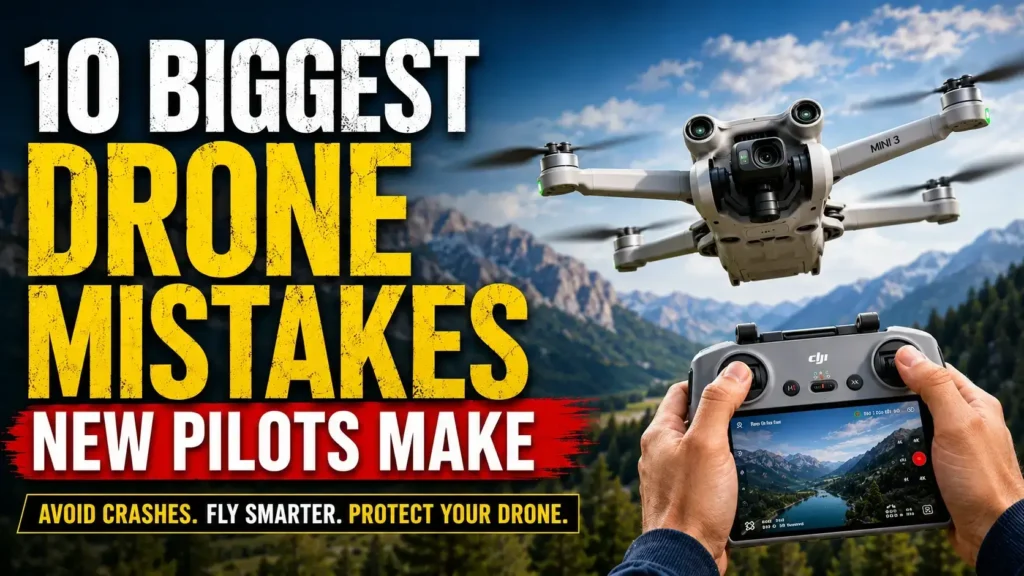
Flying a drone for the first time is an experience that combines genuine excitement with an often underestimated learning curve. The aircraft is responsive, the footage is compelling, and the temptation to push boundaries early is entirely natural. But that enthusiasm, left unchecked by a solid understanding of operational fundamentals, creates the conditions for drone mistakes that range from mildly embarrassing to genuinely expensive.
The good news is that virtually every drone mistake a beginner pilot is likely to make has been made before thoroughly documented, analyzed, and resolved. This guide covers the ten most common mistakes new pilots encounter, explains precisely why each one occurs, and provides the practical knowledge needed to ensure none of them happen to you.
Table of Contents
1. Not Knowing the Drone Laws in Your Region
All the mistakes a new pilot can make, this is the one most likely to cause immediate and lasting frustration and it is also one of the easiest to fall into. Drone regulations are not static. They are updated with meaningful frequency as aviation authorities respond to the rapid growth in consumer drone use, and what was permissible twelve months ago may be significantly restricted today.
A real-world example illustrates this clearly. A pilot returning to flying after a period away purchased a DJI Air 2S with the reasonable assumption that the regulatory landscape had remained largely unchanged. It had not. Updated UK regulations had substantially restricted where aircraft of that category could legally be flown without an additional qualification specifically, the A2 Certificate of Competency, a structured course followed by a supervised assessment. Without that certification, the aircraft’s operational envelope was far narrower than anticipated.
The consequences of flying in ignorance of current regulations fall into two categories. The first is practical disappointment: purchasing a capable aircraft only to discover that accessible, legal flying locations are extremely limited. The second is more serious flying in a restricted area, too close to people, or in controlled airspace without authorisation, which can result in confrontation, enforcement action, and reputational damage to the broader drone community.
Best practice:
- Before purchasing any drone, research the current regulations in your country or region thoroughly.
- Identify what certification, if any, is required for the aircraft you intend to fly, where you are permitted to operate it, and what conditions apply.
- Revisit those regulations periodically, as they are subject to change.

2. Failing to Update Software and Firmware Before Flying
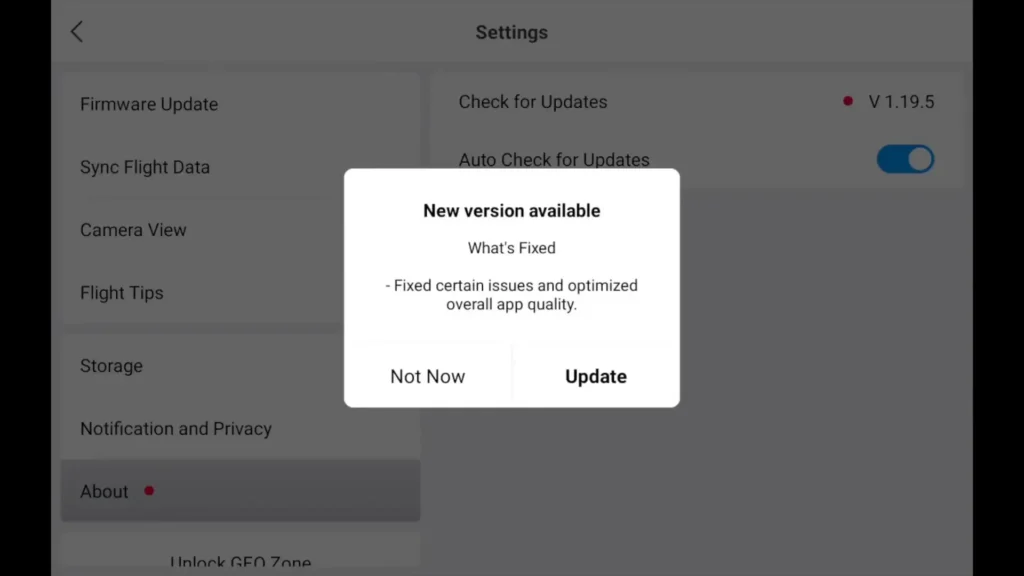
A drone that has not been updated to the latest firmware is not operating at its full capability and may be operating with known bugs or vulnerabilities that have since been corrected. Manufacturers such as DJI issue firmware updates on a regular basis, addressing everything from flight stability and obstacle avoidance performance to camera functionality and safety system behaviour. Each update represents accumulated engineering refinement that the pilot benefits from only if those updates are applied.
This issue is particularly relevant for aircraft purchased through retail channels rather than directly from the manufacturer. A drone that has been sitting in warehouse or shop inventory for several months may be multiple firmware versions behind the current release.
The software on the accompanying controller and the application installed on the pilot’s smartphone require the same attention an outdated app paired with updated firmware, or vice versa, can introduce compatibility issues that affect the flying experience.
The update process itself is straightforward and takes a modest amount of time. The return on that investment a stable, fully functional aircraft with all known issues resolved is significant.
Best practice:
- When you receive a new drone, connect it to the companion application before your first flight and allow all available firmware updates to complete fully.
- Ensure the application itself is the most current version available.
- Establish a habit of checking for updates periodically throughout your time with the aircraft, not only at the point of initial setup.
3. Failing to Properly Secure the Propellers
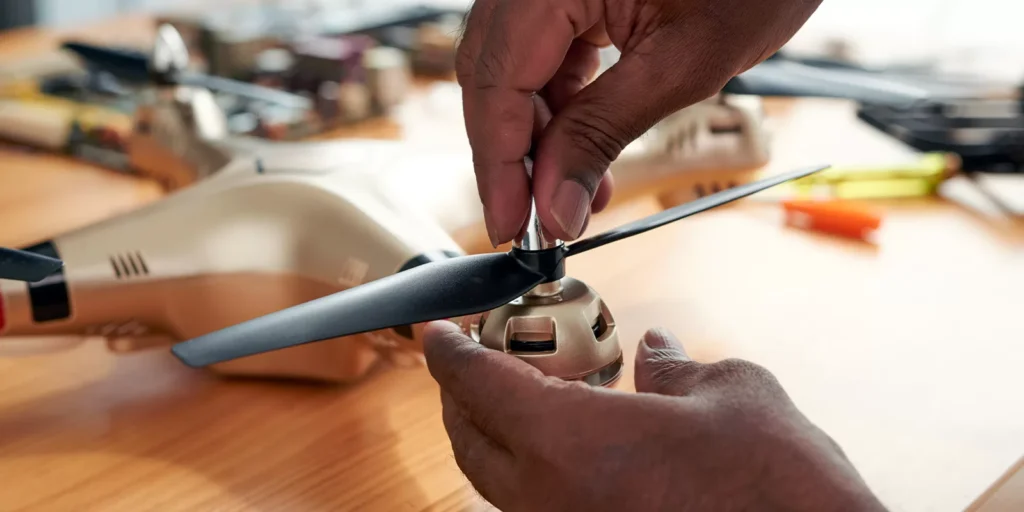
Propeller failure in flight is among the most immediately catastrophic events that can befall a drone. Unlike most other in-flight problems, a lost propeller offers no recovery path the aircraft’s ability to generate lift is compromised instantly and irrecoverably. The drone will fall.
This failure mode almost always originates not with the propeller itself, but with improper attachment prior to flight. DJI drones use one of two propeller systems: quick-release mechanisms that require a push-and-twist motion to lock, and screw-mounted propellers secured with small fasteners. Both systems are reliable when used correctly. Both are vulnerable to the same root cause a pilot who did not verify that the attachment was complete before takeoff.
Quick-release propellers present a particular risk for pilots who remove and reattach them regularly for transport. Each attachment cycle is an opportunity for the propeller to be seated incorrectly, twisted without fully engaging the locking mechanism, or left in a position that feels secure but is not. Screw-mounted propellers are susceptible to undertightening, which can allow the fastener to loosen progressively under the vibration of flight.
Best practice:
- Before every flight, physically inspect each propeller.
- For quick-release systems, attempt to pull each propeller away from its mount after locking a correctly secured propeller will not move.
- For screw-mounted systems, check each fastener individually.
- Make this inspection a non-negotiable element of every pre-flight routine, regardless of how recently the propellers were last attached.

4. Flying Beyond Visual Line of Sight
In the majority of jurisdictions worldwide, maintaining a visual line of sight with your drone at all times is not merely good operational practice it is a legal requirement. The pilot must be able to see the aircraft directly, with the naked eye, throughout the duration of the flight. Monitoring the aircraft exclusively through the camera feed on the controller screen does not satisfy this requirement.
The rationale behind this regulation is straightforward. Video signal, regardless of how robust the transmission system, is not infallible. Even modern systems operating under favourable conditions can experience interruption. When that signal is lost, the pilot’s only remaining means of maintaining situational awareness is direct visual observation of the aircraft. If the drone is beyond visual range over the edge of a cliff, behind a building, obscured by a tree line that option no longer exists.
In a signal-loss scenario, Return to Home will typically activate and navigate the aircraft back to its recorded home point. This is a valuable safety net, but it is not a substitute for maintaining proper operational awareness throughout the flight. Return to Home can fail, can navigate into obstacles, or can bring the aircraft to a location that is no longer appropriate if the pilot has moved since takeoff.
Best practice:
- Maintain direct visual observation of your aircraft throughout every flight.
- If you find yourself straining to see the drone, it is too far away.
- Fly in locations and at distances that allow you to observe the aircraft clearly at all times.
Read More; DJI Lito X1 vs Lito 1 review
5. Flying Backwards Without Surveying the Surrounding Area
Rearward flight is one of the most commonly used movements in drone cinematography. The classic reveal shot pulling back and climbing simultaneously to expand the frame from a close subject to a sweeping landscape is a staple of aerial video for good reason. It is also the movement most frequently cited in avoidable crashes.
The fundamental problem is straightforward: the drone’s camera points forward. When the aircraft is moving backwards, the pilot’s view through the camera provides no information whatsoever about what lies behind the aircraft. On drones without rearward obstacle avoidance sensors including the DJI Mini 2 there is no automated safety system to compensate for this blind spot. The drone will fly directly into a tree, a wall, a power line, or any other rearward obstacle without any warning or automatic response.
The shot on screen looks exactly as intended right up until the moment of impact. This is precisely what makes rearward flight so consistently dangerous for pilots who have not accounted for it. The footage provides no indication that anything is wrong until it is too late.
Best practice:
- Before executing any rearward flight, physically turn around and survey the space behind the drone’s current position.
- Confirm that the area is clear of obstacles to a distance greater than the planned rearward movement.
- Fly the manoeuvre slowly, with your attention divided between the camera feed and the aircraft’s physical position.
- If you cannot confirm the rearward space is clear, do not fly backwards.
6. Not Knowing Your Drone’s Stopping Distance
Consumer drones do not stop instantaneously. When forward stick input is released, the aircraft decelerates progressively before establishing a stable hover. The distance required to complete this deceleration the stopping distance varies based on the drone’s speed at the moment of input release, the wind conditions, and the specific aircraft model. A pilot who does not have an intuitive sense of this distance will, eventually, overshoot a target and strike it.
This is not an abstract risk. It plays out in practice whenever a pilot is flying toward a person, a vehicle, a structure, or any other defined point and leaves braking too late. The natural assumption for those without experience is that releasing the stick will produce an immediate stop. It will not. The drone will continue moving forward for some distance before arresting its momentum, and in the time it takes to do so, it may cover several metres.
Active braking applying reverse stick input can significantly reduce stopping distance, but only if the pilot knows to use it, knows how much input to apply, and has the reaction time to execute it correctly under pressure. All of these are skills developed through deliberate practice, not instinct.
Best practice:
- Dedicate time during your early flights ideally in a large, open area free of obstacles to systematically testing your drone’s stopping behaviour.
- Fly at progressively higher speeds and practice halting the aircraft at a defined point, both by releasing the stick and by applying active reverse input.
- Build an instinctive understanding of the aircraft’s deceleration characteristics before flying in environments where precision matters.
Read More: DJI Lito X1 VS Mini 5 Pro: The Budget Drone Battle
7. Underestimating the Hazard Posed by Power Lines and Cables
Power lines and telecommunications cables represent one of the most consistently underestimated hazards in drone flight. Their danger is not subtle contact with a live power line will destroy the aircraft immediately and almost certainly result in its loss but their visibility on the controller screen is frequently poor enough to cause even attentive pilots to miss them until it is too late.
The physics of the problem are straightforward. In the real world, power lines and cables are highly visible. They are heavy, suspended between widely spaced poles, and tend to dominate the visual field when you are standing beneath them. On a small smartphone or controller screen, at the distances and angles from which a drone typically approaches them, those same cables can become effectively invisible particularly against a bright sky, in hazy conditions, or when flying at speed.
The moment of closest approach is often the moment of least awareness. A pilot focused on composing a shot, managing altitude, or monitoring battery life may not be actively scanning for cable infrastructure, and by the time a cable becomes visible on screen, there may be insufficient time or distance to avoid it.
Best practice:
- Before flying in any new location, conduct a thorough ground-level survey of the area.
- Identify the position of all power lines, telephone cables, and any other suspended infrastructure within your intended flight area.
- Do not rely on the camera feed alone to detect these hazards during flight.
- Where cables are present, maintain a conservative safety margin and reduce speed to allow adequate reaction time.
8. Being Caught Off Guard by Wind Conditions
Wind is perhaps the most variable and least predictable environmental factor in drone flight, and its effects are consistently underestimated by new pilots. A location that feels calm at ground level can present strong and unpredictable winds at operational altitude. Wind speed and direction can also change rapidly with altitude a drone that ascends through a calm lower layer may encounter significantly stronger airflow at 80 or 100 metres than it did at 20.
The risk manifests in two primary ways. The first is being unable to return the aircraft against a strong headwind, particularly when battery levels are already reduced from a longer flight session. A drone that flew outbound with a tailwind may find the same journey back significantly more demanding, and the battery consumption required to fight a headwind can deplete the remaining charge faster than expected.
The second risk is altitude-related wind exposure over terrain where lower flight is not possible flying over a cliff edge, for example, where descent to calmer air would mean descending into the cliff face.
Best practice:
- Check a dedicated wind forecast application options such as XC Weather, UAV Forecast, or DroneBuddy provide altitude-specific wind data before every flight session.
- Be aware that wind speed increases with altitude and that conditions can change over the course of a session.
- If you encounter unexpected wind at altitude, descend lower altitude typically means lower wind speed.
- Know your aircraft’s sport mode and understand how to use it to make headway against strong wind if necessary.
- Never allow the battery level to drop to a point where a headwind return journey would be marginal.
9. Not Accounting for Return Flight Time and Battery Consumption
Battery management is one of the most critical skills in drone operation, and consistently misjudging it is among the most common ways new pilots lose their aircraft. The temptation to extend a flight session to get one more shot, to reach one more vantage point, to push just a little further is understandable, but it frequently results in a drone that does not have sufficient battery to return safely.
The calculation is not as simple as it appears. Return flight time is not just about distance it is affected by wind conditions, altitude, flight mode, and the aircraft’s speed. A drone that flew outbound at modest speed with a tailwind will consume considerably more power returning against that same wind. If the battery level when the decision to return is made does not account for those factors, the margin for safe recovery narrows rapidly.
Return to Home will activate automatically when the battery reaches a critically low level, but relying on this as the primary battery management strategy is poor practice. The aircraft is already in a compromised state when the automatic return triggers, and any complication wind, an obstacle in the return path, signal degradation, reduces the margin further.
Best practice:
- Develop a deliberate approach to battery management from your earliest flights.
- A common guideline is the
- rule of thirds
- : one third for the outbound journey, one third for the return, and one third held in reserve.
- Adjust this formula based on wind conditions, distance, and the specific requirements of your flight.
- Initiate the return journey well before battery levels become a concern.

10. Failing to Update the Return to Home Location When Moving
This final mistake is perhaps the most instructive, because it is the kind of error that no amount of theoretical knowledge entirely prepares you for it has to be encountered, or clearly imagined, to fully appreciate its implications. And it serves as a reminder that drone flight involves not just managing the aircraft, but managing the relationship between the aircraft and a constantly changing operational environment.
When a drone takes off, it records the launch coordinates as the home point. This is the location to which the aircraft will return if Return to Home is triggered, whether by the pilot manually, by low battery, or by signal loss. The home point does not update automatically as the pilot moves. If the pilot walks, cycles, drives, or otherwise relocates after takeoff, the recorded home point remains at the original launch location.
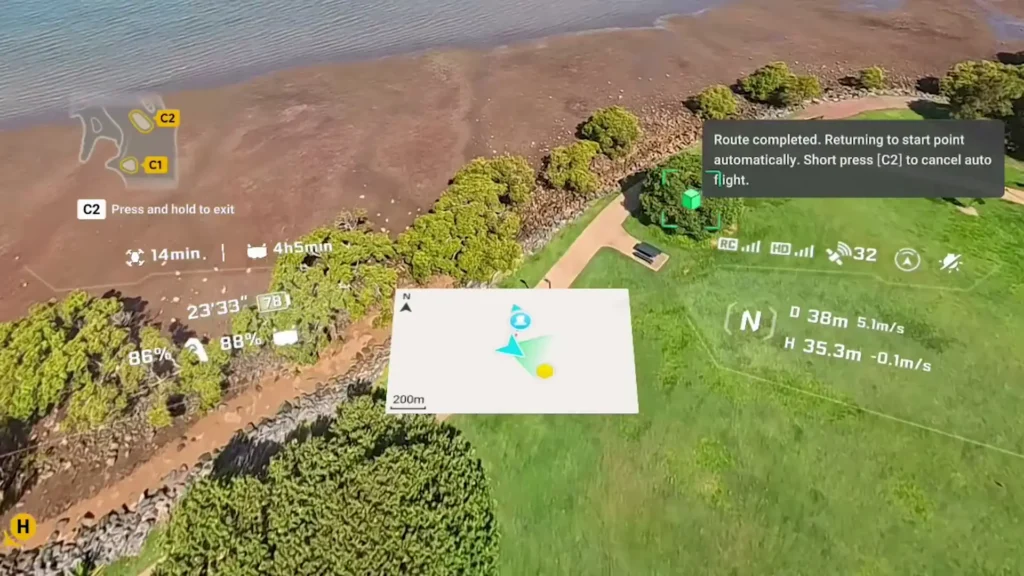
The practical consequence of this becomes critical during Active Track sessions. Consider a pilot who launches from a fixed point, initiates tracking, and moves several hundred metres from the original launch location. A signal interruption at that stage triggers an automatic Return to Home, and the drone mistake navigates back to coordinates that may now be entirely inaccessible, behind obstacles, or in an area where the pilot cannot intercept it.
This scenario played out in an instructive real-world example. During an Active Track session on a narrow private road, signal loss triggered an automatic Return to Home while the pilot was in a moving vehicle. Unable to stop or reverse, the pilot was forced to exit the car and pursue the drone on foot as it navigated back to its original launch point, an unnecessary and embarrassing situation that a simple home point update would have prevented entirely.
The same risk applies in any scenario involving movement: hiking with a following drone, operating from a moving boat, or cycling with the aircraft in pursuit. In the boat scenario specifically, the stakes are highest. A return to Home triggered after the vessel has moved significantly from its launch position can send the aircraft descending toward open water.
Best practice:
- Whenever you are moving during a flight session, update the home point periodically to reflect your current position.
- In the DJI Fly application, this is a straightforward process accessible within the settings during flight.
- Make it a habit to update the home point every few minutes during any session that involves movement, so that any automatic Return to Home event brings the aircraft back to where you are not where you were.
Final Thoughts
The mistakes outlined in this guide share a common thread: none of them are inevitable, and all of them are entirely preventable with the right knowledge applied before flight. Drone flying is a deeply rewarding pursuit, and the barrier to entry has never been lower in terms of technology and accessibility.
But accessibility should not be mistaken for simplicity. Operating an unmanned aircraft carries genuine responsibilities to other airspace users, to people and property on the ground, and to the integrity of the hobby itself.
Approach every flight with preparation, situational awareness, and a genuine respect for the limitations of both the technology and your own experience at any given stage. The pilots who enjoy the longest, most rewarding flying careers are not those who pushed hardest from the start; they are those who built their skills methodically, learned from the experiences of others, and made safety a habit rather than an afterthought.